Best of 2010

I’m sifting through the thinkhardthinkwell archives and pulling out some of my favorite posts–simultaneously fun and horrifying. Here are the Top Ten from 2010, in chronological order. Enjoy!

Posted in Links, Uncategorized | Leave a comment

Bloodlands

I’m just reaching the end of Yale history professor Timothy D. Snyder’s Bloodlands: Europe Between Hitler and Stalin (Basic Books, 2010).

This is an important book for Americans to read. We have a lot of romance surrounding World War II, for several reasons. First, the US and its allies won the war–in a relatively short period of time (Dec 1941 to August 1945). Second, it is the last war Americans can point to that nearly everyone agrees was a “just war” on our end. Indeed, my grandfather joined the Marines because he grew up admiring his older cousins who had served in WWII–though my grandfather’s experience in war (Vietnam) turned out very differently. Third, Americans’ sympathy for the Jews and their plight (as well as our historic support for the state of Israel) makes the Holocaust loom large in our cultural memory of WWII, and we like to think of ourselves as having liberated the Jews from a regime of consummate evil: Nazi Germany. This manifests itself in both serious movies about WWII (e.g., Saving Private Ryan) and films with more stereotyped portraits of Nazis (Indiana Jones movies and Inglourious Basterds come immediately to mind).

Snyder’s book does not minimize the horror and gravity of Jewish suffering in the Holocaust. Rather, his book carefully situates the various persecutions and murders of Jews within the larger historical context of two powerful regimes: first, Stalin’s Soviet Union, and second, Hitler’s rising Germany. He tells the story of Stalin’s plan to starve a third of Ukrainians in 1931, of the Molotov-Riggentrop Pact which carved up Poland and other states into spheres of Nazi and Soviet exploitation and oppression, and of the horrible loss of civilians and soldiers in Belarus, Poland, the Baltics, Ukraine, and Russia after Hitler violated the pact. The Eastern European front was far more bloody and horrific than the Western front.

Snyder tells the big-picture narrative using shocking statistics of thousands, hundreds of thousands, and millions killed–but he also includes personal testimonies that humanize the individuals behind these numbingly high figures. The sufferings of these nations (and their constituent Jewish populations) are each unique, and Snyder treats them that way.

Snyder presents to an English-speaking audience the cultural and geopolitical factors that led to the Holocaust. He speaks of how the Allies betrayed Eastern Europe, especially Poland and the Baltics, allowing them to fall under Soviet influence. (Perhaps the West didn’t know at the time how bad Soviet communism was, but there were signs that Western leaders should not have ignored.) It is all well and good to say, “Never again,” but unless we understand the cultural and political backdrop of these atrocities, they will happen again.

Bloodlands has helped me understand the historical backdrop of the setting in which I’m teaching. A third of my current students are American, a third are German, and a third are from former Soviet states, including Lithuania, Russia, Ukraine, and Moldova. As helpful as history can be, I also must resist the temptation to superimpose the histories of these countries on the individuals with which I am interacting. Most of my students are under 22, so they have no personal memory of life in their countries before the fall of the Berlin Wall and the collapse of the Soviet Union.

In his sobering conclusion, Snyder writes of the responsibility of the contemporary reader of historiography, especially the Western reader:

Ideologies also tempt those who reject them. Ideology, when stripped by time or partisanship of its political and economic connections, becomes a moralizing form of explanation for mass killing, one that comfortably separates the people who explain from the people who kill. It is convenient to see the perpetrator just as someone who holds the wrong idea and is therefore different for that reason. It is reassuring to ignore the importance of economics and the complications of politics, factors that might in fact be common to historical perpetrators and those who later contemplate their actions. It is far more inviting, at least today in the West, to identify with the victims than to understand the historical setting that they shared with perpetrators and bystanders in the bloodlands. The identification with the victim affirms a radical separation from the perpetrator. The Treblinka guard who starts the engine or the NKVD officer who pulls the trigger is not me, he is the person who kills someone like myself. Yet it is unclear whether this identification with victims brings much knowledge, or whether this kind of alienation from the murderer is an ethical stance. It is not at all obvious that reducing history to morality plays makes anyone moral. (399)

Posted in Giffones in Lithuania | 1 Comment

October Update: Greetings from Lithuania!

Dear Friends and Family:

Attached you will find our monthly update for October. Be sure to write back and tell us how we can pray for you.

In Christ,

Benj and Corrie Giffone (for Daniel and Elizabeth)

2014 Oct Giffone update.pdf

Posted in Giffones in Lithuania | Leave a comment

Best of 2008 and 2009

I’m sifting through the thinkhardthinkwell archives and pulling out some of my favorite posts. Here are the Top 13 from 2008 and 2009, in chronological order. Enjoy!

Three-part series on “Replacement Theology”: One, Two, Three

Posted in Links, Uncategorized | Leave a comment

Greatest Hits

When I was in high school, one of my favorite bands was All Star United. I appreciated their unique sound and clever lyrics. After their first two albums, I anxiously awaited their third release. But I was disappointed when they published a “Greatest Hits” CD, containing only two previously-unreleased songs.

I felt somewhat gypped in purchasing the CD just for those two songs. (Nowadays, we can just get the tracks individually on iTunes.) But I felt like a band should put out at least three (and preferably four or five) full-length albums of new material before they earned the right to produce a “Greatest Hits” album. (I found out later that ASU slapped together that compilation to meet their contract obligation and escape from their label.)

I’ve been blogging at thinkhardthinkwell for over six years. That was three graduate degrees ago. This blog is older than my children. I had thought of celebrating back in late July when the actual anniversary of my first post rolled around, but I was a little busy with a transatlantic move and all. But now that I have some time, I’ll be republishing some of my favorite posts–maybe a “Top 5” for each calendar year. It’s both encouraging and humbling to see what was rattling in my head and happened to pop out. I certainly don’t like or agree with everything I wrote–and that’s probably good.

For now, I’m reposting the very first entry, entitled, “Biblical Economics,” published on July 30, 2008. Economics has been an interest of mine since Mrs. Fagerlund’s class in high school, and it has been a recurring theme in my writing. Enjoy!

As we seek a biblical model of economics, we must first examine what is perhaps the most basic idea in economics: the tension between scarcity and insatiability. Scarcity is simply the truth that all physical resources are finite. Insatiability is the idea that human beings are always in want, trying to get something more. In other words, “we can’t always git what we want.”

It should not be surprising that these observations about the world and human nature are taught as truths in Scripture. First, there are many verses that talk about the desire to accumulate possessions, some with a positive spin and some with a negative. Much of the Old Testament narratives are concerned with the acquisition of the Promised Land and the blessings that accompany the Davidic kingdom. Secondly, however, many teachings of Scripture take for granted the human desire for self-interest. Paul, for example, appeals to the Christians’ desire to receive the blessings given to Christ and the rewards of His kingdom as he urges them to press on in their faith. Pursuit of true self-interest is not condemned by Scripture but accepted as a part of being human, with the understanding that what is truly in one’s best interest is to obey God.

When God begins His creative program, He begins with a “wild and waste” earth. By the process of creation, He “tames” the earth, first by creating light, then by putting the chaotic waters in order, and then further pulling back the waters to reveal land. God’s creation is His cultivation of order. He then gives Adam, as His representative, the mandate to continue and finish the project. God placed Adam in a paradise, but it was a work in-progress-Adam was to name the animals and cultivate the plants. It should not be thought that insatiability-Man’s quest to fulfill his desires-is a product of the Fall, but rather the original state of Man’s creation. Had Adam sat and twiddled his thumbs, he would presumably have starved! Through obedience to God, Adam’s needs and wants would have been met. Only the Creator can truly sate the hunger of the Creation.

In the post-Fall world, scarcity is more acute. The ground will only produce by Man’s sweat and toil. Given Man’s desire to live and prosper, he must find new ways of getting what he needs to stay alive.

Posted in Links, Uncategorized | Leave a comment

Stealing God’s Thunder

“And you shall not go up by steps to My altar, so that your nakedness will not be exposed on it.” (Exod 20:26)

“For Aaron’s sons you shall make tunics; you shall also make sashes for them, and you shall make caps for them, for glory and for beauty. You shall put them on Aaron your brother and on his sons with him; and you shall anoint them and ordain them and consecrate them, that they may serve Me as priests. You shall make for them linen breeches to cover their bare flesh; they shall reach from the loins even to the thighs. They shall be on Aaron and on his sons when they enter the tent of meeting, or when they approach the altar to minister in the holy place, so that they do not incur guilt and die. It shall be a statute forever to him and to his descendants after him.” (Exod 28:40-43)

“None of the daughters of Israel shall be a cult prostitute, nor shall any of the sons of Israel be a cult prostitute.” (Deut 23:17)

“In the year of King Uzziah’s death I saw YHWH sitting on a throne, lofty and exalted, with the train of His robe filling the temple. Seraphim stood above Him, each having six wings: with two he covered his face, and with two he covered his feet, and with two he flew. And one called out to another and said: ‘Holy, Holy, Holy, is YHWH of Armies! The whole earth is full of His glory!'” (Isa 6:1-3)

“So the next day they rose early and offered burnt offerings, and brought peace offerings; and the people sat down to eat and to drink–and rose up to ‘play.'” (Exod 32:6)

Hebrew scripture is unanimous in condemnation of cultic sexual behavior, as the quotations from Deuteronomy and Exodus 32 illustrate. Scripture frequently links cultic sexuality to the worship of gods other than YHWH.

But if sexual behavior within marriage is acceptable–even pleasing–to YHWH, why couldn’t marital sex (between a priest and his wife, for example) be part of Yahwistic worship? Indeed, the ability to consummate a marriage is a prerequisite for being a priest in YHWH’s service (Lev 21:13, 20; cf. Deut 23:1). The Song of Songs celebrates the relationship of YHWH and his people using the vivid metaphor of marital sex. When I was a teenager, I read a book about dating and sexual purity that likened sex within marriage to a “two-person worship service!”

Despite the essential goodness of sexual union in marriage, nowhere does scripture condone the performance of marital sex as part of ritual. In fact, the passages cited above from Exodus 20 and 28 and Isaiah 6 emphasize the importance of covering up sexual organs in the presence of YHWH for worship. Steps to YHWH’s altar are forbidden, so that the priest’s or worshiper’s robe will not come up and expose the private parts, even for a second (Exod 20:26). Furthermore, Aaron and his sons, the priests, must wear special undergarments to ensure that their “loins and thighs”–both words are euphemistic for genitals–are completely covered in YHWH’s presence (Exod 28:40-43). Even the heavenly beings–the seraphim, winged serpents that worship YHWH day and night, which are never associated with any sort of sin–cover their “feet” (another euphemism for genitals) with their wings in YHWH’s presence.

So, if sex within marriage is good, and the priests are expected to have marital sex and produce children, why is scripture so adamantly against even a hint of sexuality (such as the partial exposure of private parts) in YHWH’s presence?

The answer may be found, I believe, in the ability of humans to reflect YHWH’s creative power as his images. In the sexual act, a man and a woman are capable of doing something that only YHWH can do: create another imago Dei. It is good and right that human beings do so (within the bounds that YHWH has prescribed). But this creative act should not even be alluded to in worship, where YHWH himself and YHWH alone is the object of adoration as Creator. To expose sexual organs or celebrate sexuality in worship is to “steal God’s thunder” as the one from whom humanity’s creative power is derived.

The idea of marital sexual behavior as part of a worship service is not likely to gain much traction in most Christian churches. Yet there is a trend in some churches toward speaking frankly and openly about the particular details of marital sex from the pulpit. Because historically many people inside and outside the church have considered sex to be dirty, these churches are trying to reclaim marital sex as something good and beautiful (so, “Why Should the Devil Have All the Good Sex?”).

But I wonder whether marital sex can really be re-sanctified by simply talking about it in church, without any concern for whether the topic is addressed with reverence and gravity. It’s one thing to encourage wives and husbands to be available to one another and to seek to please one another sexually–and quite another thing to tell wives from the pulpit to go home, pull down their husbands’ pants, and perform oral sex (the actual teaching of a well-known pastor who is in the news quite a bit right now). Do our public statements in worship about sex and sexuality communicate in our Creator’s presence the due reverence for this creative act? Or in our quest for “relevance” and overcoming legalism, have we sullied that which we tried to celebrate as beautiful? Are we playing catch with our dad’s baseball that was signed by Babe Ruth?

Posted in Bible-Theology | 3 Comments

September Update: Greetings from Lithuania!

Dear Friends and Family:

Laba diena! Greetings from Lithuania! After a few weeks of adjusting, we are excited to share with you what things are like and what has been happening.

MOVING AND SETTLING

Our travels on August 11-12 went quite smoothly; we were blessed to have Benj’s mother fly with us, and then stay for ten days to help us get established. We figured out the grocery store and the bus system together, and enjoyed some fun sightseeing excursions, including the amber museum, the sea museum and aquarium on the Curonian Spit, and a dolphin show.

We love our first-floor apartment. It is on the end of the building, so we have windows on three sides with a nice view of the garden and the pond. It is perhaps slightly smaller than our old Lansdale apartment, but it has plenty of storage space. Daniel loves his loft bed, with room underneath for his train set, and he has decorated with wall stickers and posters from friends. He also has a bicycle with a basket and a bell. The previous occupants were very kind to leave behind miscellaneous cleaners, spices, office supplies, tools, toys, etc., which has made the transition much smoother.

Pray that we will quickly feel at home here and be thankful for all that we have, without dwelling on the things that we left behind.

There is not nearly as much English spoken here as we expected, though we can still get around fine. Benj and Corrie will each take a semester-long class to learn basic Lithuanian. Benj goes out with a group of guys for fun on occasion, and enjoys prayer and conversation with his colleagues. Corrie is getting to know the other faculty wives and will be part of a women’s Bible study. We are considering whether to send Daniel to a Lithuanian preschool part-time to learn the language and have some time with other children; we are slowly discovering other kids his age, but it will take some time and effort to get to know them. In the meantime, he loves doing preschool work with Mommy at home. Elizabeth is walking quite well, and wanders around the house turning off the lights because she is just tall enough to reach the switches.

Please pray for fast-forming relationships that will give us a support network. Pray for our language studies. Pray for wisdom in discerning and managing the needs of our children.

MINISTRY

Benj started classes on Monday, September 1. As students arrived, it was fun to see license plates from Russia, Ukraine, Moldova, Georgia, Finland, Latvia, Estonia, and many other countries. There is also a significant contingent of students from USA colleges and universities spending a semester abroad.

The first day of school involved a convocation, followed by a parade through town with students and faculty of the other Klaipėda universities. Benj teaches Pentateuch, New Testament Epistles, and Hebrew. He is adjusting to a schedule where he sets his own hours and gets to spend all day doing work that he actually enjoys. We will be hosting his students in our home over the next few weeks to meet them, so many thanks to all of you who contributed hot chocolate packets! Corrie will soon start helping with discussion in an introductory Bible class. Over half of the students have never read the Bible before. The discussion panel of staff and faculty serves to answer student questions and show examples of lives transformed by a personal relationship with God through His Word.

Please pray for time management, for clear teaching, and for wisdom in connecting with the students at the appropriate level, both academically and spiritually.

The last few weeks, we have attended Miesto Bažnyčia (City Church), which holds services in Lithuanian with translation into English and Russian. The pastor and his family invited us and some other LCC families over for a pancake breakfast to get to know us. The number of Protestants in Lithuania is small (estimated at less than 1%), but City Church is growing and will meet this year on the LCC campus. LCC faculty and students hope to get more involved with this church this year.

Pray for unity among the Christian churches in Lithuania. Pray for City Church and its ministry in Klaipeda. Pray for Christians at LCC to join in and serve among the people of this church. Pray for us to wisely choose how to get involved.

IN TOUCH

We love to hear what’s going on in your lives! Email is fine, but phone calls and Skype are greatly appreciated as well. Our phone number is 267-498-7208, which is a domestic call from the USA but rings a phone right in our living room through the miracle of the interwebs. Remember that it is 7-10 hours later here (Eastern Europe Time)! But if we miss your call, leave a message and we will call you back.

Our mailing address is:

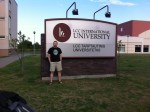
Giffone, c/o LCC International University

Kretingos g. 36

Klaipėda, Lithuania 92307

We’ve attached some pictures from our first month, and here is a link to a video tour of our apartment.

SUPPORT

We praise God that our first year is fully funded, and we are nearly half way there for next year! Thank you as always for your generous care for us. We are reaching the time of year when many churches are making their budgets for 2015. If you think that your church might be interested in supporting us, please put us in touch with your missions committee. Pray that God would continue to meet all our needs.

______________

Thank you all for your prayers and support. Stay tuned for further updates; be sure to follow us on the web and join (and share) our Facebook group. To receive monthly updates about happenings at LCC, you may wish to sign up for the university’s newsletter, Transformations.

In Christ,

Benj and Corrie Giffone (for Daniel and Elizabeth)

______________

(If you would like to unsubscribe to these email updates, please respond to benjamingiffone and let us know. No hard feelings—I promise! We get lots of email, too.)

Posted in Giffones in Lithuania | 1 Comment

The Academic Life (or, How to Think Thoughts Professionally)

We’ve now been in Klaipėda for seventeen days. The first week was spent getting settled into our on-campus apartment and familiarizing ourselves with the city. We also made quite a few sight-seeing trips into town with my mom, who left last Friday for an excursion to Denmark and Germany before returning to San Diego.

Though I had meetings last week, this week has felt more “academic”: meetings, syllabi, finalizing course outlines, etc. Suddenly, in this week between “getting settled” and “oh-my-goodness-students-are-here,” I am faced with a strange new challenge: how to structure my day as “a professional thinker”?

Up until this point in my life, the academic pieces–reading for general knowledge, class preparation, research and writing–have fit in around the larger, immovable blocks of my life–primarily, a 7.5-hour workday. But now, instead of only having 12:00-1:00 and 3:30-5:30 to work on these things, I have 7:00-whenever! I have been hit with an avalanche of “free time,” and it’s hard to know how best to use it all.

As I wrote a few years ago, I’m not entirely convinced that I can do more with a 5-hour bloc of research time than with a 2-hour bloc. So I’m working on parceling out my work into 2-hour chunks, around lunch and meetings. Starting next week, I’ll have classes to work around as well. But therein lies another difficulty: How can I know when I’m completely prepared for a class? The only classes I’ve taught up to this point have been compressed, so the attention of both student and teacher is undiverted by other courses. In those contexts, the boundary on class prep is very easy to see: the bell rings, and it’s time to teach–whatever you’ve got. Here, I could literally spend hours and hours on each class hour, and still not feel “ready.” For now, I’m convinced that I will never feel completely ready for any class, so I just decide on a stopping point. I’ll let you know next Friday how that goes.

There are three other pieces that fit into this time: reading for general knowledge, non-class academic projects, and support-raising (including keeping in contact with current supporters). Each of these are accounted for in my overall time allotment (I think), but when to do them? Which ones will tend to squeeze the others out if priorities and boundaries aren’t set? Right now, the only external boundaries I have are a deadline for a book review to be submitted to a journal. But just beyond the horizon I know there will be paper proposals for 2015 conferences, and emails/calls to pastors and missions committees about 2015 church budgets.

With these worthy and important responsibilities competing for my attention, it’s easy for me to feel guilty about those pieces that seem more self-interested. “How,” I ask myself, “can I be worrying about my own bank account and CV, when I could be preparing to teach students?” Yet I know that the generous support of individuals and churches back home is what allows me to stay here–if there’s no money, there’s no teaching. The sorts of research and reading that make me a well-rounded teacher will also enable me to keep my position here at the university in the long term, which is good for students and for the university (I flatter myself).

So, where do I find that balance? My dep’t chair and my colleagues will no doubt be a tremendous service to me in this respect. The chair has already emphasized to me several times that support-raising, research, and family life (another important piece) all need to have their significant places in my schedule, and time is allocated for them.

But the most important thing is my own attitude and focus. These two texts stood out to me this week:

They said, “Come, let us build for ourselves a city, and a tower whose top will reach into heaven, and let us make for ourselves a name, otherwise we will be scattered abroad over the face of the whole earth.” (Gen 11:4)

Unless the Lord builds the house,
They labor in vain who build it;
Unless the Lord guards the city,
The watchman keeps awake in vain. (Ps 127:1)

The test of my attitude is: Am I adding this brick to the edifice (note the overlapping etymologies of “edifice” and “education”) of my life to make a name for myself, or am I doing it to make the name of Jesus Christ known in all the world?

Posted in Giffones in Lithuania, Research | Leave a comment

August Update: Greetings from Lithuania!

Dear Friends and Family:

Greetings from Lithuania! We completed the 24-hour journey from Perkasie to Newark to Copenhagen to Palanga to Klaipėda, across 7 time zones.

MOVING

After a two-hour drive to the Newark Airport (in a 14-passenger van, courtesy of Chelten Church), we said a tearful goodbye to Corrie’s parents.

Our flights went about as well as could be hoped. The kids did great on the eight-hour transatlantic flight to Copenhagen—both slept some, and when they were awake they were well-behaved. A very helpful SAS agent in Newark rearranged our seats so that we could all sit in the same row (the best I had found was two-and-two), and we had to pay one fewer extra-bag fee than we had anticipated, so I was happy!

After a five-hour layover in Copenhagen, we had a one-hour delay for mechanical difficulties once we boarded the plane for Palanga (Lithuania). But after switching to another plane, we enjoyed a beautiful afternoon flight across the Baltic Sea. My first impression of Lithuania is that it looks like northern Wisconsin: mostly flat, with lots of evergreen trees.

Some LCC colleagues had kindly stocked our fridge with some essentials, so we had food when we arrived. My mother (who has been invaluable) went to the local grocery store and made us a tasty, healthy dinner. She flew in from San Diego to accompany us, so it’s a ten-hour time difference for her; she is still asleep as I write this at 11am EEST—poor thing!

We are gradually putting all our things away, and learning about the campus. Our apartment is beautiful and larger than we had imagined, with nice furnishings, lots of closets, and a serviceable kitchen. Daniel was particularly excited to see the garbage dumpsters and recycling receptacles. He also likes his loft bed with room underneath for his trains. This evening, one of our neighbors (the wife of one of my theology dep’t colleagues) will show us how to get around on the bus, to the bank and the store, etc.

You can see pictures of our journey on Facebook (I’ve attached a few as well).

MINISTRY

Please pray for us as we settle in and get to know new friends and colleagues. Pray for me as I begin to prepare in earnest for my classes.

SUPPORT

Right before we left, we received a support commitment that put us at 98% for the first year! We are only $500 short of our budgeted amount—Praise God! We are so grateful for all your prayers and your generous gifts.

______________

Thank you all for your prayers and support. Stay tuned for further updates; be sure to follow us on the web and join (and share) our Facebook group. To receive monthly updates about happenings at LCC, you may wish to sign up for the university’s newsletter, Transformations.

In Christ,

Benj Giffone (for Corrie, Daniel and Elizabeth)

______________

(If you would like to unsubscribe to these email updates, please respond to benjamingiffone and let us know. No hard feelings—I promise! We get lots of email, too.)

Posted in Giffones in Lithuania | Leave a comment

Five-Year Plan (non-Soviet-style)

In May 2010 when (7-months-pregnant) Corrie and I made the decision that I would pursue graduate education in Old Testament with the goal of teaching, I made a five-year plan for academic goals. I found this document the other day. Here’s the list of what I had hoped to achieve by the end of 2015:

*Publish two articles in academic journals
*Preach a sermon series
*Present two papers at national conferences
*Present two papers at regional conferences
*Teach courses in two different academic contexts/institutions

*Submit dissertation proposal – end of July 2010
*Complete first quarter of dissertation July 2011
*Second quarter of dissertation July 2012
*Third quarter of dissertation July 2013
*Finish draft dissertation July 2014
*Revise, defend dissertation July 2015

On September 1, I will have attained all these goals except for one: I have only presented one paper at a national academic conference. (But I’m gunning for two papers in November of 2015, so hopefully that one will be knocked out as well!) Things didn’t go exactly as I’d planned: I had to write a master’s thesis as well as a dissertation, and the dissertation ended up taking only 18 months. On this side of the process, I can’t imagine dragging it out over five years as I had tentatively scheduled here–I would have lost momentum and never finished. As rewarding as it was, I thank God that it is behind me!

The whole reason behind this list was to make me employable as a Bible professor. I am now an assistant professor, preparing to do the best job in the world: teaching the Bible. I am most blessed among men (and women)!

Posted in Research | Leave a comment