Too Small

To the political junkie, to the sports fan, to the gossip girl, the historian says: Your narrative is too small.
Posted in Uncategorized | Leave a comment

Update: Candidacies, Proposals, Teachings

I realize that it’s been a while since I’ve blogged substantially. I feel responsible to give an account of my previous few weeks, with the hope that the next few weeks will result in more bloggable thoughts and experiences.

After spring conferences, I turned my focus to a doctoral proposal. Having experienced LFS (Lamentations Fatigue Syndrome), I turned my attention to Chronicles. After several go-’rounds with Prof. Jonker, I finally put something workable together. The tentative title is: “Sit at My Right Hand: The Chronicler’s Portrait of the Tribe of Benjamin in the Social Context of Yehud.” Last week, the proposal was approved by the Faculty of Theology at Stellenbosch, so I am officially a PhD candidate.

A few weeks ago I had the privilege of visiting the meeting of the Eastern Pennsylvania Presbytery of the PCA, with the goal of being accepted as a candidate for ordination. It was an encouraging time of worship, fellowship, teaching–and parliamentary procedure! My candidacy was accepted, and my internship proposal approved. (It helps when your supervising Teaching Elder is the chair of the Leadership Development Committee.) I received a charge from Galatians 2:20, “It is no longer I who live, but it is Christ who lives in me. And the life I now live in the flesh I live by faith in the Son of God, who loved me and gave himself for me.”

This will be quite a quarter of instruction. I am teaching Numbers and Deuteronomy in Sunday school at church; it’s been challenging to adapt class material from an academic context to a church context. But people seem to be enjoying the class as much as I am–anyway, the ones who aren’t enjoying it aren’t telling me…

I’m also preparing to teach my first graduate class, Introduction to Interpretation of the Bible, at PBU. This course presents three particular challenges. First, it is a new course for me–it’s always tough preparing new material. Second, the object of the course is theological, rather than the text of Scripture. It’s much easier for me to show up and talk about a book of the Bible, than to talk about the Bible and how we should read it. Third, it is a compressed-format course, involving three weekends of 13 teaching hours on Friday and Saturday. There’s no room for error–either sink or swim the first weekend! But I am relishing the chance to reconsider my own views on Scripture and how they have evolved since I was a student at PBU.

To round out the explanation of the title of this post: I’m currently working on another proposal regarding church ministry, which it is not appropriate to speak of yet–but hopefully the time will come when I can share it. It’s good news–I promise!

So, some nuggets on Numbers-Deuteronomy, Chronicles, Doctrine of Scripture, worship music, economics, the New Jersey Devils–or anything else–may be coming your way in the ensuing weeks. Keep checking, and thanks for your prayers.

Posted in Bible-Theology, Research | Leave a comment

Romans 15: “I Have a Dream”

“I Have a Dream” is a sermon I preached at Preakness Valley United Reformed Church in Wayne, NJ, on April 22, 2012. The text is Romans 15:14-33. Here is the MP3 audio (30:26, 27.8MB), and an excerpt:

Paul’s plan was to go to Judea, then to Rome, and then go on to Spain. But there’s no evidence that Paul ever got to Spain. In the book of Acts we read of Paul’s arrest in Jerusalem in chapter 21, and from that point on he is a prisoner, first in Judea, then during the long, shipwrecked journey from Jerusalem to Rome via Cyprus and Malta, and finally under house-arrest in Rome. According to church tradition, Paul was eventually executed in Rome for his faith.

So, he never made his “mission trip” for which he sent out this grand, marvelous support letter! Looking back, we can see that God in his Providence allowed Paul to dream of going to Spain, so that he would write the book of Romans, which is Paul’s great masterpiece. Paul had his grand plans for God, but God’s plans were even more grandiose than Paul could ever imagine.

Audio and text: ©2012 by Benjamin D. Giffone. Reproduction and distribution are permitted, providing that the author is properly credited and that no fee is charged.

Posted in Bible-Theology | Leave a comment

Links: 21 April 2012

As an American studying abroad, I was surprised to discover that Stellenbosch, a public university, has a school of theology that trains ministers for the Christian church. Prof. Brand in the Department of Systematic Theology and Ecclesiology has written an interesting essay on the teaching of confessional theology at a public university.

Mom faces jail for baptizing her 2 kids without husband’s consent.

An interesting experiment in top-down planning: an Ikea neighborhood. Even as a fan of Hayek and bottom-up organization, I am interested to see if this will work.

Yes, Facebook is most assuredly making us lonely.

Here is another reason among many to oppose war, which kills men and makes women suffer from the resulting gender imbalance.

Posted in Links, Uncategorized | 1 Comment

Lamentations and the Holocaust

Sometimes the suffering soul needs to be given a voice rather than chicken soup….

As I have studied the book of Lamentations over the past two years, the recurring theme that stands out to me is the importance of giving voice to those who are suffering. This theme surfaces often in discussions about the Shoah (Holocaust), its victims and its survivors. Rather than seeking some sort of explanation or trying vainly to right the many wrongs done to the Jews, this vein of thinking seeks to proclaim the fact of violence and suffering, to give voice to those who have been silenced.

This is an important fact that Americans are not very good at accepting. We think that we can change everything with the right combination of persuasion and force. When we see someone suffering, our reaction is to try to find an explanation and to fix it. But sometimes there is no explanation, nor is there a real solution. The book of Lamentations briefly dwells on a shred of hope in YHWH’s faithfulness (3:21-24)–but concludes that YHWH has utterly abandoned his people to shame, suffering and death (5:21-22). To the extent that we try to explain away the anguish expressed in Lamentations, we blunt the sharp point of its message: let the sufferer be heard.

Today, on Yom HaShoah (Holocaust Remembrance Day), may those voices be heard.

Posted in Bible-Theology, Culture-Economics-Society, Research | 3 Comments

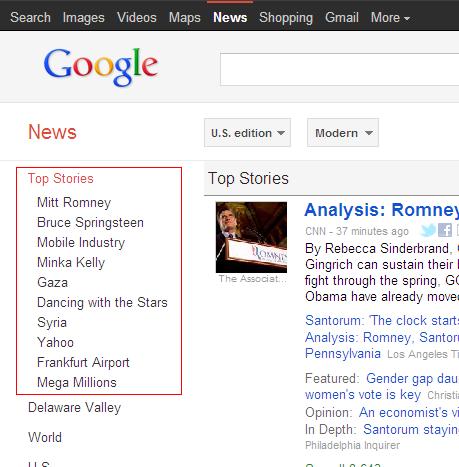
Cultural Mirror

No disrespect to The Boss or Minka Kelly, but what does this say about our culture?

Posted in Culture-Economics-Society | Leave a comment

A Bedtime Story

There once was a group of business owners who owned competing businesses. These business owners formed an oligopoly: between them they controlled nearly all of their nation’s trade in their product. As members of an oligopoly tend to do, these business owners banded together in collusion–something which was illegal in that country–yet they were granted a special exemption from antitrust legislation by their government.

These colluding businessmen (nearly all were male) were constantly looking for ways to gain a negotiating advantage over their employees, who had also instituted collective bargaining. After years of scheming, the business owners devised a new and innovative way of lowering their labor costs.

Labor is, in many industries, the primary cost to employers, and this oligopoly industry was no exception. Hiring employees involves quite a bit of uncertainty: an employee may add more value to his employer’s product than he costs that employer in wages–or he might not. So, the business owners thought, what if there were a way to force prospective employees to work for no wages for up to five years? Then, those of the best quality would rise to the top. The prospective employees would then bear all the risk: if they were injured on the job, they would receive no compensation for lost wages.

The business owners set about putting this plan into action. They set up a dummy corporation, for which all prospective employees in the industry must work for a minimum of a year, and often up to five years. The employees of this dummy corporation were paid less than minimum wage (even though their managers made top salaries). The profits from this dummy corporation were paid to the business owners’ wealthy friends, who in turn passed those profits to the business owners through various legal channels.

The employees targeted by this dummy corporation were mostly poor and members of minority groups. Often these employees worked for four or five years for next to nothing, hoping to prove themselves worthy of a big payday. Yet most did not make the cut, and many sustained serious injuries for which they received no compensation or disability benefits.

But the business owners cared little. The profits rolled in: the most productive employees–the lucky few–made it into the industry proper and made a decent living for several years (before sustaining serious injuries). The managers of the dummy corporation made nearly as much as the oligopoly businessmen. But the majority of the prospective employees, who were often the most gifted members of their struggling communities–continued to squander their most productive years, making millions of dollars for other people, and putting their livelihoods at risk, in the slim hopes of achieving a chance for a single big paycheck for themselves and their loved ones.

And that, boys and girls, is why we have college basketball and football. Sweet dreams!

Posted in Culture-Economics-Society | 2 Comments

Of making many books there is no end, and much study is a weariness of the flesh

I haven’t had much time to blog over the last two months. I know that my faithful readers check daily for updates and are disappointed. I beg your forgiveness…

When I returned from South Africa after a successful thesis defense and a vacation with my bride, I dove (or dived) right into papers for ETS and SBL spring conferences. Both conferences were enjoyable, and my work was well-received. My ETS paper is posted on the Papers & Presentations page; I did not post the SBL paper because I am hoping to publish it very soon. My MTh thesis, “From Time-Bound to Timeless: The Rhetoric of Lamentations and its Appropriation,” is linked as well.

I’m currently throwing all my energy into my dissertation proposal, which I hope to have completed by the end of April. I am also teaching a summer graduate class at PBU in June, so May and June will be devoted to preparation/grading.

Daniel is as cute as ever, and he learns more words each day. He is having a difficult time learning that he must not stand on the couch, or touch the microwave or TV. He spends quite a bit of 30-second segments in “timeout.” But he is a pleasant boy who loves his parents and his grandparents, and is generally healthy and happy. We are grateful.

I am visiting PBU and Westminster today, adding briefly-annotated bibliographical entries to my Chronicles notes…

Posted in Research, Travels | Leave a comment

Links: 5 March 2012

December 30, 2011: The day that never happened (in Samoa).

An interesting article in BAR: "Cultic Practices at Tel Dan—Was the Northern Kingdom Deviant?" I typically hate archeology, but this article is relevant to my research into the periods of the late monarchy, the exile and the postexile. Any thoughts?

Another humorous critique of the state of American higher ed. Full disclosure: I have three degrees (including two master’s degrees) in biblical studies–yet I work in the pharmaceutical industry.

Posted in Links, Uncategorized | Leave a comment

Conference Paper: “Economic Failure of the Torah?”

Yesterday I attended the Eastern Regional meeting of ETS with my sister, Rebekah Devine.

In past years, I have attended these meetings for the fellowship, for the book sales, and sometimes to present a paper–without much interest in the keynote speaker or the plenary topic. This year’s speaker and theme, however, were excellent. Peter Leithart spoke on his new book, Defending Constantine. I am not a Patristics scholar–nor am I the son of a Patristics scholar–but I found Leithart’s presentation compelling as history. As someone associated with the so-called “Federal Vision,” Leithart drew the FV-theonomist-Reformed crowd from PBU and elsewhere, so it was nice to connect with old friends.

Dr. Leithart was so gracious as to attend my presentation during the opening parallel session: “The Economic Failure of the Torah? Toward a Post-Industrial Reading of an Agrarian Text.” I was very pleased with the attendance and the feedback, including some comments from Dr. Leithart and Dr. Todd Mangum from Biblical Seminary. If you are interested in reading and/or hearing the presentation, the PDF and MP3 audio are posted on the Papers and Presentations page.

Rebekah received one of the prizes in the graduate student paper competition for her paper entitled, “No god Made With Hands: Pauline Idol Polemics.” Her paper will soon be posted online, along with the other winning submissions, on the ETS website.

What a fun day! Soli Deo Gloria.

Posted in Research | 1 Comment