Seeing my breath

This morning I headed out my front door in suburban southeast PA, and I could see my breath.  According to my dashboard, it was 52º F at 6:30am.  If you are ever so unfortunate as to spend any length of time in my presence, you will know that I don’t like being hot at all, and that I would prefer that there be only two seasons: autumn and winter.  The chilly air was quite invigorating, and I zipped up my fleece and rolled down the windows as I zipped along the winding roads out to 309.
 
 
I used to hate the autumn when I was young, because I loved playing hockey and wiffleball all summer but hated school.  When I got to college and realized that I actually liked learning, I began to appreciate the other aspects of autumn.  I love tossing the football in the backyard with friends; I love watching the World Series (unless, like last year, I detest both teams).  I love the new school year, with fresh possibilities and undiscovered truths–welcome renewal of the mind after a hot, busy summer of work and travel.
 
This will be the first September in quite a long time that I will not be heading “back to school.”  My dissertation proposal has been submitted, and now I’m working on a few other research projects.  But there will be no first day of class, with new books,  friends old and new, and a fresh GPA.  There will be no “first day of school” photo of my wife, as there have been for the previous twenty-one Septembers: K-12, then five years of college, and finally three years as a teacher.
 
Remember when you first learned to ride a bike?  Your dad ran alongside your bike as you got moving, and then you looked back for a second–and he was thirty feet behind you!  I fear that formal education too often convinces us that we cannot learn without training wheels or a parent huffing and puffing beside us.  My graduate education taught me how to study and love learning on my own, for its own sake–not simply as a means to an end.  I hope and pray that I can “keep riding” sans training wheels in this next season of life.
Posted in Uncategorized | 5 Comments

A Biblical Studies degree and a pizza

My best man finished his undergraduate studies last year. His course of study spanned ten years and three institutions. He worked hard, and his wife is very proud of him (and relieved). After a B.A. in Mathematics, he’s now beginning an M.A. in Philosophy. I always used to tease him about his chosen course of study with this joke: “What’s the difference between a degree in philosophy and a pizza?” “I don’t know–what?” “A pizza can feed a family of four!”

Of course, my teasing Diggs about studying philosophy is the equivalent of the raven calling up the pot and saying, “Hey, Pot! The Kettle called–it wants its color back.” Six years ago, I passed up a full engineering scholarship in order to study ancient texts for a living. Now, I’m working for big pharma, just at the start of a doctoral program in OT, and it could be years before I “make a living” in this field. I’m not ungrateful–just impatient at times.

Would I do it differently? No–maybe some individual choices would be different, but my chosen course would be the same. John Hobbins over at Ancient Hebrew Poetry has written an insightful post about the value of a degree in Biblical Studies:

A degree in biblical studies – or a text-based degree in religious studies – is not much more than a piece of paper if it does not develop your ability to collate and analyze data in cross-disciplinary fashion – at a minimum, linguistic and literary analysis; hermeneutics; political theory; philosophy of religion; comparative law, theology, and eschatology; the history of the text’s reception within Judaism and Christianity and the wider culture….

What good is a degree in biblical studies if you earned it at an institution that did not teach you to work collaboratively? If it did not teach you to “cultivate humanity” by coming to an understanding of societies, cultures and civilizations different from one’s own?

If you can’t make sense out of ancient Israel and the movements to which the writings of the New Testament and the Talmud and Midrashim are a witness, what chance is there that you will make sense out of the hopes and fears of your next-door neighbor in the global village?

At PBU, I certainly took some courses that were designed to churn out cookie-cutter dispensationalists who could teach Sunday school from the Scofield Bible. But more of my courses taught me to examine the texts critically and carefully, and to look at all of life with a discerning eye in accordance with Scripture. Thankfully, the school is moving in the latter direction.

I have been given the opportunity to teach a week-long course at PBU’s Wisconsin campus (WWC). In late October, I will be working through Numbers and Deuteronomy with 30 freshmen up in the mountains. I’m very eager to jump right in and engage the texts in study. But more importantly, I’m trying to remember myself–circa 2003, my first semester of college, my first time living away from home. What was I thinking and feeling? Where was I spiritually? Emotionally? Intellectually? How do I reach the minds and hearts of these young men and women?

Posted in Uncategorized | 2 Comments

Brett McCracken in the WSJ

Brett McCracken, author of Hipster Christianity, has written a thoughtful piece on the WSJ website. McCracken offers a scathing critique of evangelical churches that use stunts like sex billboards and online services to attract the young folks. Here’s a choice line:

Are these gimmicks really going to bring young people back to church? Is this what people really come to church for? Maybe sex sermons and indie- rock worship music do help in getting people in the door, and maybe even in winning new converts. But what sort of Christianity are they being converted to?

I’d be interested to hear your thoughts on this article. Does a spoonfull of sugar really make the "medicine" more palatable, or does it just make the kid hyper when he should be sleeping because he’s sick?

(HT: Blakester)

Posted in Uncategorized | 5 Comments

Grammatrain’s back!

Koeljamm brought this to my attention: Grammatrain, one of our favorite bands from the ’90s, is back after a hiatus of over 10 years! They’ve released video of their entire reunion concert, and it’s available for free download here. You can also watch the whole concert on Youtube.

Nice to have you back, boys…

Posted in Uncategorized | Leave a comment

No Big Government–unless it helps me

I was in the restroom today (which is the only place I read magazines anymore), and I was browsing this week’s issue of Time. I don’t usually care much for Joe Klein’s column, but he has some astute observations about the Senate race in Kentucky. I was a big fan of Dr. Ron Paul back in ’08; he seemed to have some traction that I wish the Libertarian Party had been able to harness. But now Congressman Paul’s son, Dr. Rand Paul, is running for the Senate seat vacated by HoF pitcher Jim Bunning.

Regarding the younger Paul, Klein writes:

The campaign has not been a comfortable experience for Paul; he has been forced to eschew the courage of his father Ron Paul’s convictions. Libertarianism is a basic American political impulse, but ideology isn’t. People don’t want the government on their backs, except for when they do. And so Paul on the stump seems a man perpetually in the act of biting his tongue. His Fancy Farm speech limned the more popular libertarian talking points: the tax code is 16,000 pages long; the federal regulatory code is 79,000 pages long. But the real meat of his message consisted of four words: “Barack Obama … Nancy Pelosi.” In fact, he would just say each name, let it hang in the air and then repeat it.

Klein has put his finger on two problems with political discourse. The average American will of course affirm that he likes liberty, freedom and individual responsibility–until he needs welfare, unemployment benefits, or a book banned from the library. We are quick to compromise some ideal of liberty when someone else’s liberty gets in the way of what we want. Second, the span of our collective attention is about that of a fruit fly’s life on this earth. Dr. Paul could deliver an articulate, thoughtful speech, some of which the crowd will like and some of it they won’t. But when they leave the rally, all they will remember is those “four words.”

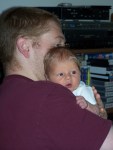
My son is three weeks old. Sometimes when he’s crying, I’ll just blow gently in his face. He gets flustered, sputters a bit–and then forgets what he was crying about. Too often, our elected stooges are able to divert our attention just as easily:

Posted in Uncategorized | Leave a comment

Evolving in Monkey Town

Right now, I’m listening to an interesting book called Evolving in Monkey Town, by Rachel Held Evans. A young evangelical, Evans chronicles her experiences growing up fundamentalist in the American South and attending a very conservative Christian college.

So far, much of her experience seems similar to mine. I plan to review the book when I’m done, but I’d be interested to know if and what you’ve heard of the book, and what you thought of it.

Posted in Uncategorized | Leave a comment

More Daniel Pictures

Here’s some more pictures that are not up on Facebook…

Posted in Uncategorized | Leave a comment

More graven images

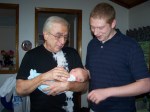
If, as some cultures believe, a photograph steals a bit of its object’s soul, then my son ran out of soul last Thursday. As the first grandchild, great-grandchild, nephew, grandnephew, etc., on both sides of the family, this kid has been shot more times than A-Rod going for his 600th homer. Here are a few more…

Posted in Uncategorized | Leave a comment

Is it possible to do violence to a text?

When I read a text, I feel that it is important to read that text “on its own terms,” insofar as I am able.  By this, I mean reading it in its original context as best as I can understand it.  Some texts lend themselves quite naturally to application in other contexts: Aesop’s Fables are didactic, fictional parables designed to teach a lesson; one of the reasons we enjoy poetry is that it evokes feelings within us or communicates and elaborates feelings we already have.  The text lends itself to being read in a certain way, and so applying that text is being faithful to it.

Is it possible to violate a text?  I believe so.  To affirm that texts can be used unfaithfully or inappropriately is to assume that there is an objective standard by which a use of a text can be judged.  Who is that judge?  What appropriations might be considered to be out of bounds, and how can we know?

Maybe it’s just something we know intuitively, like Justice Potter Stewart said of pornography: “I can’t define it, but I know it when I see it.”  Well, I know that Pride and Prejudice and Zombies is out of bounds–but why?

Regarding biblical texts, I believe that there are valid and invalid (faithful and unfaithful) appropriations of these texts in various contexts.  My tendency is to overemphasize the historical situation of a text and underappreciate the application of a text in an alien context.  This stems from my perception that modern Christian interpretation has abandoned a rich redemptive-historical reading of Scripture in favor of a purely exemplaristic or “applicationalistic” reading of the Bible; rather than letting the text say what it “wants to say,” we mine the text for things that interest us personally.

But maybe I’m too restrictive.  Is it arrogant to think that history matters?  I think that we need permission from the genre and situation of the text to draw application in other contexts.  For example, the poems of the Psalter have been composed, edited, compiled and preserved for liturgical use; therefore, it is right that Christians and Jews read them personally (though historical perspective still provides an added dimension of meaning).  Other texts can be more complicated to read.  Ezra-Nehemiah, for example, provides examples of people who are obedient to God—excellent.  However, the message of the book demonstrates that YHWH’s presence is not fully with his people after the Return as it was before the Exile.  Both readings are important, but the text itself points us toward the latter.  (And my Christian faith certainly affects my reading of Ezr-Neh, because I want to see Jesus as the true Return of YHWH to dwell with his people.)

The very fact that these texts were preserved for us means that they are supposed to be read and perpetuated in the life of the faith community.  So, there is “application”—or at least import—to the genealogies, the Holiness Code, the laments, the histories of Esau and Hezekiah.  What is it?

Posted in Uncategorized | 5 Comments

A Prayer

YHWH, your mercies are new in the morning and great at night. You are faithful to your promises, remembering your covenant to children, and to children’s children.

YHWH God, my sins are great. I stand before you as Israel: broken and lost, in need of your grace. My only plea is the blood and righteousness of your Son, your Messiah, your faithful suffering Servant, the one in whom Israel’s and Adam’s purposes are summed up.

For Jesus’ sake, and for the sake of your covenants of promise: forgive my sins, restore me to fellowship through your Holy Spirit, and grant that my life would henceforth be honoring and pleasing to you, for your satisfaction and for the sake of your Name.

Amen.

Posted in Uncategorized | 1 Comment