
Our family is working through the book of Samuel in our morning devotions. Even having studied this book extensively–taught OT Narrative Lit several times, and written two books and several articles that touch on the subject–I’m struck once again by how intricate and nuanced the stories are. I have other topics I’m writing on at the moment, but I hope to come back and write an article on the laws (economic, ritual purity, vows, etc.) that are presumed behind the book of Samuel.
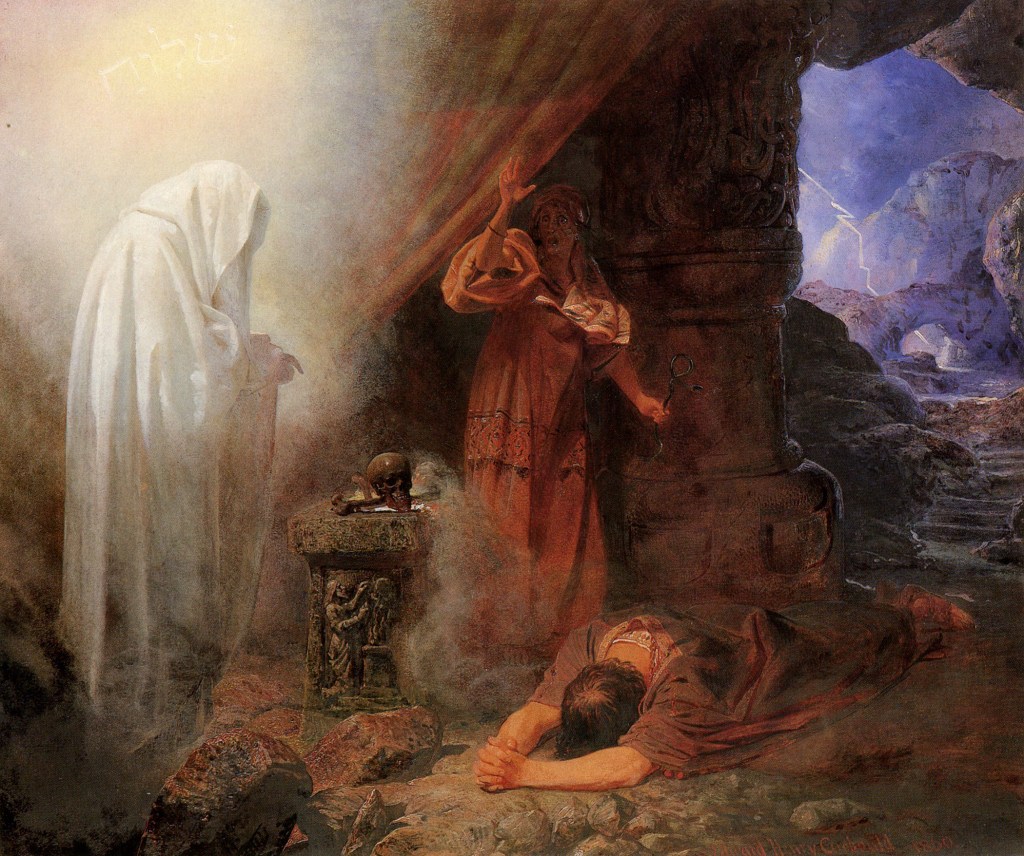
For yesterday’s reading, we looked at 1 Samuel 28, in which Saul consults the medium at En-dor (not this Endor) in advance of his battle with the Philistines, which turns out to be his downfall. There are many interesting aspects to this passage.
I had a student last year who wrote a paper on 1 Samuel 28 in South Asian context. It was a very interesting paper, informed by his Christian community’s encounters with spiritualists and mediums. One of the things that we discovered as he was doing his research, as that historic Christian interpreters have been divided on the question of what exactly the medium (and possibly Saul) actually witnessed when she conjured Samuel’s elohim.
There are basically three sorts of opinions. First, it could be argued that the medium was a fraud: she was making up the vision of Samuel and what his elohim was “saying” to Saul. It could very well be that the medium was typically engaged in fraud with her other clients, which is why she was surprised by Samuel’s spirit/elohim actually appearing in the séance. But if she were actively defrauding Saul in this case as well, why would she make up a “Samuel” who prophesied negatively against Saul? Wouldn’t she be more inclined to put words in Samuel’s mouth like, “You will be very rich and successful!”?
I don’t think that there is any indication in the story that the woman was a fraud, unless we believe that necromancy is impossible. There is just too much evidence from many cultures to rule out that she was capable of actually talking to the dead, via some dark spiritual powers. Also, it is hard to understand why these practices would be forbidden in Deuteronomy 18:10–12 if they did not have any draw based on real power.
A second opinion is that the elohim that appeared to be Samuel was actually a demon (or Satan himself) pretending to be Samuel, misrepresenting itself to the medium. This makes more sense of the use of the term elohim, which can mean “God,” but also gods, angels, or spirits. Heiser (Unseen Realm, 30) argues that this term just means a non-corporeal being, which could include demons, angels, YHWH, or even the souls of humans who have died physically (see third option below).
The difficulty with the “Demon Impersonator” view is that everything the elohim-Samuel says, comes to pass, which is the sign of a true prophet (Deut 18:21–22). If this were a malevolent spiritual being from Satan—or a deceiving spirit from YHWH’s divine council, as in 1 Kings 22:19–23—then it wouldn’t tell Saul the truth about how he would die in battle with the Philistines the following day.
A third opinion is that the elohim really is the conjured spirit of physically-dead Samuel, speaking from beyond the grave. This makes sense of the situation in ways that the other interpretations don’t make sense. But it is difficult to square with other biblical texts that seem to consign the souls/spirits of dead people to heaven, hell, She’ol, Hades, or the realm of the dead. There is no other clear biblical evidence that the souls of the dead are accessible to the living.
What my student Ringgathing and I found interesting about this passage is that the prevalent Christian interpretation seems to have shifted dramatically between the Patristic era and the Reformation era. We consulted the ACCS and the RCS volumes on 1 Samuel, and found very different opinions.
The Patristic interpreters generally (minus Tertullian) believed that Samuel’s spirit was actually conjured by the medium (Option 3)–this was an issue of the veracity of scripture for them. Here is Franke’s summary:
To suggest that Samuel was not brought up by a medium is tantamount to saying that the Scripture’s record of history is not true. Since the Holy Spirit speaks the words recorded in Scripture, their veracity is assured. Brought up by a medium, Samuel demonstrates that the God of the patriarchs is the God of the living. Samuel’s presence in hades, like Jesus’, demonstrates that every place is in need of Christ (Origen). Given the power to deceive, the witch of Endor brought forth Satan, who was transformed into Samuel, a man of light (Tertullian). Since souls survive after death, as Samuel’s return proves, people should strive to be good so that their souls don’t fall under a wicked power (Justin Martyr). That the soul rises in the form of a body is indicated by Samuel’s appearance (Methodius). While the soul extends or contracts itself to fit the body, it does not similarly adapt to clothing. Samuel’s appearance in bodily form suggests that the mind inhabits another [spiritual] body when it leaves its material one (Augustine).
John Franke, ACCS OT Volume 4, Joshua–2 Samuel
Here is a scanned excerpt in PDF if you want to read the section.
On the other hand, all of the Reformation commentators surveyed by Cooper & Lohrmann took the “Demon Impersonator” view. They were concerned about any hint that the spirits of the dead were accessible to the living, likely due to their opposition to the Roman Catholic practices of praying to saints and praying for the dead. Here is that excerpt, scanned.
While I am not an expert in either of these domains, I do regard reception history as relevant for biblical interpretation and preaching. Often, pre-modern Jewish and Christian interpreters noticed important dimensions of the texts that moderns miss.
It is unusual, from what I have seen, to see such a swing in interpretive approaches between the Patristic era and the Reformation era. No doubt both sets of interpreters were trying to genuinely and faithfully exposit the Scriptures–but it is impossible to ignore the ways in which their worldviews, their contexts, and their apologetic concerns influenced their interpretations. We would be wise to keep aware of how our interpretations of the Bible are influenced by our contexts.

 think hard, think well
I found this very interesting! Thanks for the reminder to be aware of how my interpretations of the Bible are influenced by my context.