
Longtime readers of this blog will know about my interest in economics, which goes back to high school, at least. (My mother tells me that my late grandfather, whom I didn’t know that well, majored in economics in college–maybe it’s genetic.) It’s been an aspiration of mine to publish something about economics.
I have tried to incorporate insights from political economy literature into both of my monographs, but neither ancient historians nor political economists have quite known what to make of my writing in that vein. (A few years ago even reached out to a politics professor in Scotland whose work on ancient Rome I had found interesting, but he read over some of my chapters and didn’t feel that he could offer any helpful feedback.)
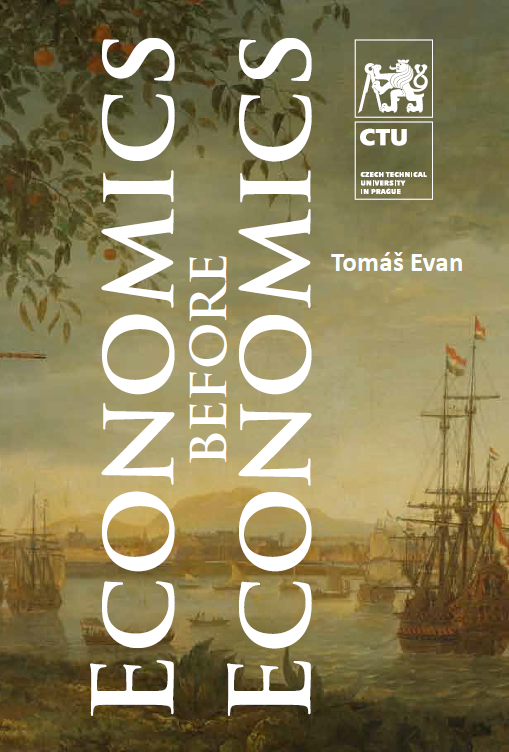
I’m pleased to announce that one of my minor dreams has come true. A economist colleague of mine from the Czech Republic, Tomáš Evan, has just published a book of economic history, and I am listed as a coauthor (with another economist, Jonathan Warner) for contributions to two sections and some work editing the book overall. The project took about five years since Tomáš first approached me about being part of it, and the book ended up looking quite different than I expected when I agreed.
But it’s now in print, and I congratulate Tomáš for all his work. I don’t think you can buy it from the USA yet, but here is where you can see the front matter and first chapter.
Tomáš Evan, with Jonathan Warner and Benjamin Giffone, Economics Before Economics: Chapters of History of Economic Thought before Adam Smith (Prague: Czech Technical University Publishing, 2024). ISBN 9788001072875.
Here is the backstory, if you’re curious. I had met Tomáš when he visited LCC on an Erasmus+ fellowship, and we hit it off, talking about Calvinism and economics. (He has written previously about the theological innovation of Calvinism that allowed for the charging of interest, the precondition for modern economic investment.)
Tomáš approached me in 2019 about writing a chapter for a book, which he explained would be about the historical development of economic concepts before the great turning point of Adam Smith (Wealth of Nations, and The Theory of Moral Sentiments).
For this book, he wanted me to write about economic concepts in the Hebrew Bible, which of course is my area of specialty. I agreed, but on the condition that I invite my CFHF economist colleague, Jonathan Warner, to coauthor with me. Both Tomáš and Jonathan were amenable to this arrangement.
As Tomáš had initially described the book, I assumed that it would be an edited volume with many specialists writing about different ancient and medieval civilizations and texts. Jonathan and I were not sure exactly what would be useful for the overall thrust of the book, so we drafted a study of economic concepts in the HB that we knew would be too long and comprehensive, but would allow Tomáš to select what was most relevant. We sent Tomáš an initial draft in the summer of 2020.
As the project took longer that expected through COVID (poor Tomáš was teaching online and homeschooling his kids!), Jonathan and I were eager to see some of these ideas out there–and also, I wanted to self-cite the study in a number of other projects I was working on (as one does). So we posted the too-long draft online as a pre-print (you can still read that here). I think it holds up and reads well as a standalone essay.
In the meantime, Tomáš also asked Jonathan to draft something about the contributions of the New Testament to economic thought, and Jonathan agreed to that also.
When Tomáš checked back in with us in 2022, he was ready to incorporate our material into his book–but clarified that the rest of it was authored by himself! I was surprised, but pleased to see the draft coming together, as I generally agreed with his thesis and approach. So we set about trying to edit and incorporate material from both the HB and NT chapters into the book. Both ended up looking quite different–focused, and shorter. Along the way, I ended up making some contributions to the NT bits, and also reading the whole book for consistency and to link up the sections on later thinkers with the biblical bits.
For the purposes of accreditation reporting (and royalties–woohoo!), we agreed that Jonathan and I together were responsible for 13.3% of the book (though that seems like spurious precision to me). I would have been satisfied with credit in the acknowledgements, but Tomáš insisted that we be listed as coauthors (you can see the front matter pages in PDF on the publisher’s website).
So that is how I came to be 6.65% coauthor on an economics book. Congratulations again to Tomáš, and thanks for letting me and Jonathan be part of it!

 think hard, think well
Thanks for the link to 13.3% of the book!