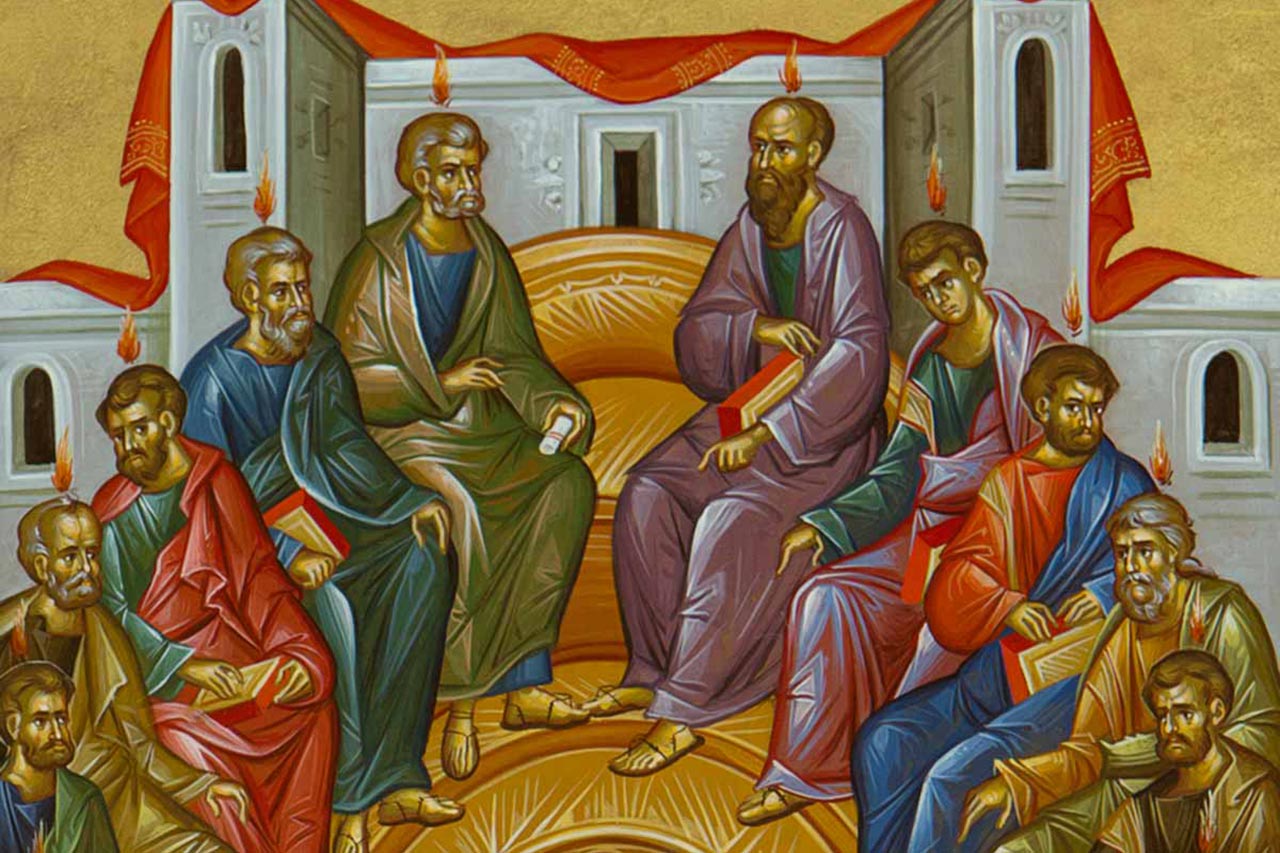
Sermon: Acts 2 and Isaiah 28:5-13, Pentecost

This is the audio (40:21, 36.9 MB) of a sermon preached at our Lithuania home church, Klaipėda Free Christian Church, on May 23, 2021: Pentecost. The main text is Acts 2; I also make reference to Isaiah 28:5-13.

Enjoy hearing the sermon in both English and Lithuanian (back-and-forth)! You can also watch the service on Facebook, including the sermon starting at about 35:00.


Audio and text: ©2021 by Benjamin D. Giffone. Reproduction and distribution are permitted, providing that the author is properly credited and that no fee is charged.

Posted in Bible-Theology, Giffones in Lithuania | Tagged , , , | Leave a comment

Sermon: Called to Community (Philippians 4:10-20)

This is the audio (50:10, 38.1 MB) of a sermon preached at the Kaunas Free Christian Church, on May 16. The main text is Philippians 4:10-20.

Enjoy hearing the sermon in both English and Lithuanian (back-and-forth)! You can also watch the service on YouTube, including the sermon starting at about 46:00.


Audio and text: ©2021 by Benjamin D. Giffone. Reproduction and distribution are permitted, providing that the author is properly credited and that no fee is charged.

Posted in Bible-Theology, Giffones in Lithuania | Tagged , , | Leave a comment

Sermon: A Testimony to the Powers (Ephesians 3:1-13)

This is the audio (41:27, 37.9 MB) of a sermon preached at our Lithuania home church, Klaipėda Free Christian Church, on April 18. The main text is Ephesians 3:1-13.

Enjoy hearing the sermon in both English and Lithuanian (back-and-forth)! You can also watch the service on Facebook, including the sermon starting at about 33:00. It was an all-family affair: Corrie led worship on piano, and Elizabeth played percussion—while Daniel was responsible for the on-screen text.


Audio and text: ©2021 by Benjamin D. Giffone. Reproduction and distribution are permitted, providing that the author is properly credited and that no fee is charged.

Posted in Bible-Theology, Giffones in Lithuania | Tagged , | Leave a comment

Sermon: Matthew 21:1-11, Palm Sunday

This is the audio (31:21, 28.7 MB) of a sermon preached at our Lithuania home church, Klaipėda Free Christian Church, on March 28, Palm Sunday. The main text is Matthew 21:1-11; I also make reference to John 1:9-13 and Zech 9:5–10.

Enjoy hearing the sermon in both English and Lithuanian (back-and-forth)! You can also watch the service on Facebook, including the sermon starting at about 22:10.


Audio and text: ©2021 by Benjamin D. Giffone. Reproduction and distribution are permitted, providing that the author is properly credited and that no fee is charged.

Posted in Bible-Theology, Giffones in Lithuania | Leave a comment

Article on Technology, Worship and Deuteronomy Now Available

Under the terms of publication, I am now permitted to post my 2019 article, “Technologising of Word and Sacrament: Deuteronomy 14:24–26 and Intermediation in Worship” (European Journal of Theology 28.1 [2019]: 66–77).

Continue reading
Posted in Bible-Theology, Culture-Economics-Society, Research | Tagged , , | Leave a comment

Reading Scripture with the Chronicler

On March 3, 2021, I had the honor of presenting a talk to the faculty and students of Spurgeon’s College (London), as part of their weekly postgraduate seminar. (As is seemingly every academic event these days, the seminar was conducted via Zoom.) My presentation was entitled, “Scripture Reading Scripture: Can the Chronicler Teach Us How to Interpret and Apply the Bible?”

Continue reading
Posted in Bible-Theology, Giffones in Lithuania, Research | Tagged , | Leave a comment

Sermon: Job 42:10-17, “Receiving Double from YHWH’s Hand”

This is the audio (48:21, 44.2 MB) of a sermon preached at our Lithuania home church, Klaipėda Free Christian Church, on February 28, Second Sunday in Lent. The sermon is titled, “Receiving Double from YHWH’s Hand.” The main text is Job 42:10-17; I also make reference to Isaiah 49:14-23.

Continue reading
Posted in Bible-Theology, Giffones in Lithuania | Tagged | 2 Comments

Joshua 22: Should We Believe the Transjordan Tribes?

A few months ago, Corrie and I were working through the Old Testament with the kids in our morning readings; we had previously read Genesis and Exodus, and so we picked up with Leviticus and read straight through to Kings up until Advent. I like having kids who are insistent upon reading the Bible itself (not a kids’ Bible or summaries), and they seem to enjoy it as well. It has been an interesting exercise to read a passage, and consider its interpretation and application “on the fly,” and to present it in a way that is relevant and interesting for a 10- and a 7-year-old. (It is a challenge to do this before Elizabeth gets fidgety!)

We discussed at length Joshua 22, in which the Transjordan tribes (Reuben, Gad, and half of Manasseh—Gilead) return to their inheritance after helping the other tribes conquer their territory. I’ve thought a lot about these 2½ tribes and their presentation in Numbers–Judges, and I’m struck by the ambiguities in this story. On its face, the narrative presents a potentially explosive situation, that ends up resolved peacefully. But is that all that is going on, or is there more to it?

Continue reading
Posted in Bible-Theology, Research | Tagged , , | 2 Comments

Sermon: A People Yet to Be Created

This is the audio (25:00, 22.9 MB) of a sermon preached at our Lithuania home church, Klaipėda Free Christian Church, on December 13, Third Sunday of Advent. The sermon is titled, “A People Yet to Be Created.” The main text is Psalm 102:18–22; I also make reference to the lectionary readings for this Sunday.

Continue reading
Posted in Bible-Theology, Giffones in Lithuania | Tagged , , | Leave a comment

On In-Person Worship, Civil Authorities, and Christian Freedom

I’ve prepared an essay entitled, “Technologising of Worship Before and During Pandemic: Epistemology, Eschatology, and Presence,” which is under review with a journal. However, I wanted to share portions of it here before publication, for the benefit of anyone who might be interested.

In his excerpt, I argue that Romans 13 and 1 Corinthians 8 cannot be used to justify Christian leaders’ acceptance of government orders to cease in-person worship, even during a pandemic.

Some might object to strenuous insistence on the essentiality of in-person worship, on the grounds that Christians are obliged to respect civil authorities (Rom 13:1–7), and should be willing to lay down our rights for the sake of others (1 Cor 8:9–13). While these considerations should not be blithely dismissed, such biblical texts and principles cannot faithfully be deployed as justification for suspending in-person worship.

Within the long history of wrestling with Romans 13:1–7 (and related texts) and the relationship of the civil authority, with great diversity of opinion within the Christian family—there is unanimity in the tradition that civil disobedience is justified when civil authorities seek to prevent the proclamation of the gospel (e.g., Acts 4:19–20). To the extent that corporate worship is necessary for gospel proclamation and the formation of disciples (which we will consider below), civil disobedience is justified.

Some Christian leaders argued that 1 Cor 8:9–13 should lead us to lay aside our rights for the good of the community, so that Christians should not assert or exercise their rights to gather for worship, and pastors should not place a stumbling block in the way of their congregations by meeting against the orders or recommendations of government authorities. This interpretation fails to account for the context of 1 Cor 8, where the end to which Paul exercises his Christian freedom (in refraining from eating idol-meat) is in fact embodied fellowship with fellow Christians. Laying down Christian rights to avoid stumbling others involves making necessary accommodations so that others feel safe and welcome coming to worship and enjoying table fellowship. This may entail significant restructuring of worship spaces and ritual acts for health and safety (see the discussion of various technologised restructurings below), so that those who are more vulnerable may join the gathering with as low a risk as possible. Opening the church for worship and allowing individuals to weigh the gains of participation against their own personal risks actually respects the freedom of other believers; closing indefinitely is robbing them of knowing God’s love in a way that is essential for human life.

Christians living under oppressive regimes have long understood that gathering for worship is essential for continuing in the Christian faith—after all, Christians in the book of Acts routinely violated government bans on worship and preaching the gospel. Though Christians in modern secular societies such as Europe and North America must guard against the “martyr complex,” neither should they regard the secular state as an empathetic ally. Civil authorities in secular society, I have argued, do not possess the categories to fully reckon with the “essentialness” of worship—and will therefore never appropriately balance public health concerns with the need for corporate worship. It is therefore the role of Christian leaders to speak out both for the safety of the vulnerable and for the rights of individuals to gather, mediating in good faith between the state and their communities.

Biblically, we must affirm that worship of the Triune God of the Bible is essential to human existence. Human beings were created to give God glory, and we find ourselves living most fully into our image-bearing vocation when we worship. Worship is necessary for a kind of “knowing” that is essential to our human existence, and worship is the chief end of human existence. Without worship, we cannot know who we are or fully be who we ought to be. Modern secular society does not have the categories to assess or embrace this truth claim, and therefore will never successfully balance this aspect of our human identity with other concerns (like economics or physical safety). In the worldview where “religious experience” is merely a construct that brings comfort, community and an ethical framework, worship cannot be an end in itself.

©2020 Benjamin D. Giffone. All rights reserved.

Posted in Bible-Theology, Culture-Economics-Society, Research | Tagged | Leave a comment