
-

- photo 1
-

- photo 2
-

- photo 3
If you’d like to read more of my work on Chronicles, you can check out this page.
Don’t forget to subscribe on iTunes, and email us if you like the show or have questions: benjamingiffone [at] gmail. Please be sure to “like” and share our Facebook page!


In the culture department:
In the economics department:
On a more lighthearted note:
The word of God is a tree of life that from all its parts offers you fruit that is blessed. It is like that rock opened in the desert that from all its parts gave forth a spiritual drink. He who comes into contact with some share of its treasure should not think that the only thing contained in the word is what he himself has found. He should realize that he has only been able to find that one thing from among many others. Nor, because only that one part has become his, should he say that the word is void and empty and look down on it. But because he could not exhaust it, he should give thanks for its riches. Be glad that you are overcome and do not be sad that it overcame you. The thirsty man rejoices when he drinks and he is not downcast because he cannot empty the fountain. Rather let the fountain quench your thirst than have your thirst quench the fountain. Because if your thirst is quenched and the fountain is not exhausted, you can drink from it again whenever you are thirsty. But if when your thirst is quenched and the fountain is also dried up, your victory will bode evil for you. So be grateful for what you have received and don’t grumble about the abundance left behind. What you have received and what you have reached is your share. What remains is your heritage. What at one time you were unable to receive because of your weakness, you will be able to receive at other times if you persevere. Do not have the presumption to try to take in one draft what cannot be taken in one draft and do not abandon out of laziness what can only be taken little by little.
(HT: Ross Wagner)
I’m hoping to get back to our usual schedule of “Friday links” next week. Things have been a little irregular over the Christmas break–we were away last weekend (travelogue forthcoming)
But here are some interesting stories I’ve read over the last few weeks on Ukraine and Russia. These situations are constantly in flux, so some of the info may now be [significantly] dated. But hopefully you will find them informative, if this interests you.
Ukraine Vote Takes Nation a Step Closer to NATO.
Ukraine’s complicated path to NATO membership.
Russian warning: No gas for Ukraine if it fails to pay $1.65bn debt by next week.
Why Ukraine’s internally displaced have given up hope of returning home.
Who Gets Hurt With Russia’s Falling Ruble?.
Ukraine Briefly Cuts Power to Crimea Amid Dispute With Russia Over NATO.
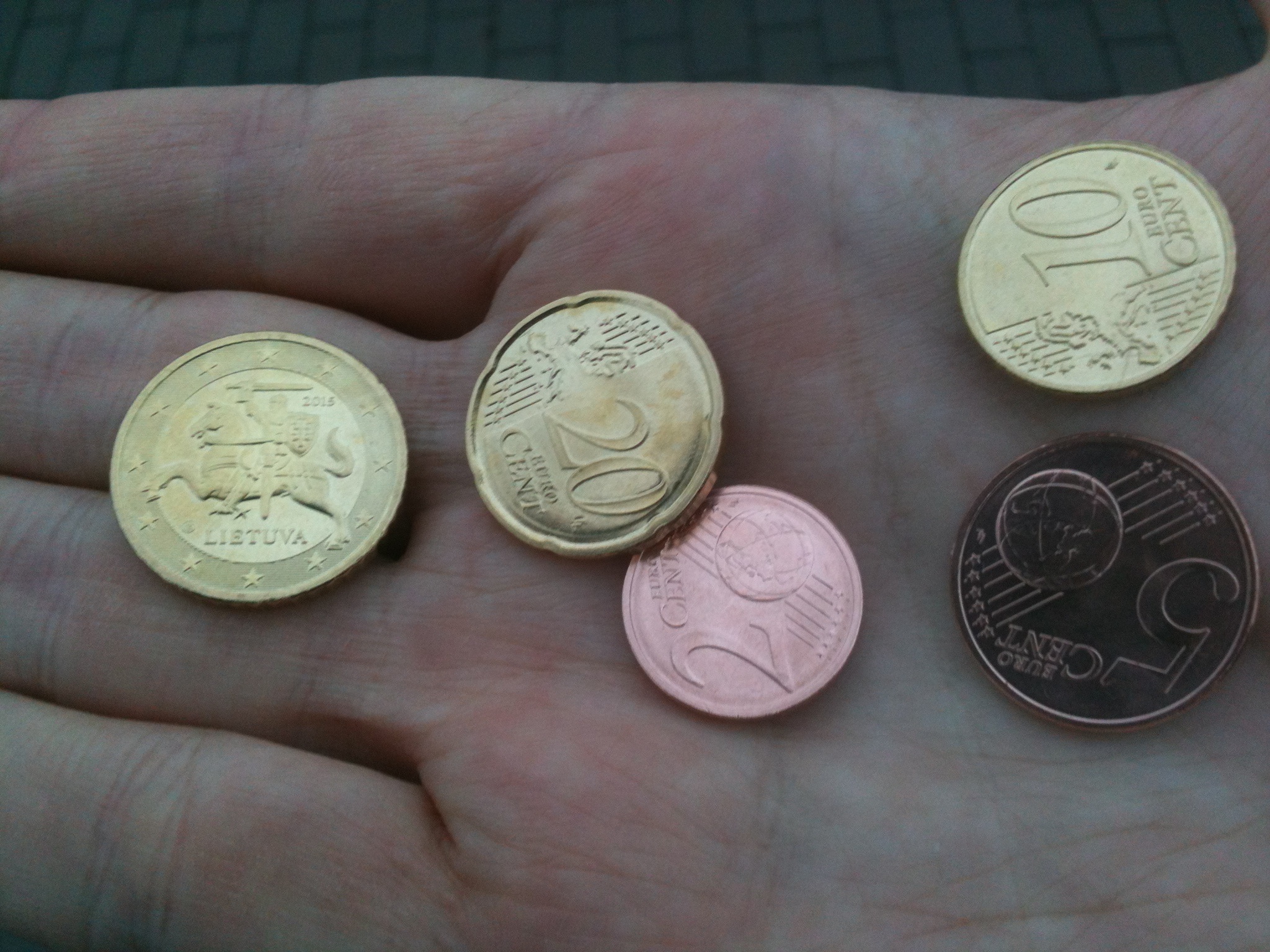
I’m out enjoying a coffee on New Year’s Day, reading the book of 1 Enoch for class. I purchased my mocha with litai and received my change in euros. So far, there has been no rioting in the streets and no explosions–except all the fireworks set off at midnight last night. Here’s hoping that the transition to the Eurozone is as smooth as butter on a bald monkey’s pate!
I’ve been considering how to follow up my post about how ministering in Eastern Europe as an American has affected my political views. I realized that I others have probably written about this issue, and also that I’m under no obligation to provide all the answers on this blog (good thing for my wife and family).
But I would like to give just a few examples of how “It’s complicated,” as I mentioned in that post. I’ll start out by posting an email that I sent to a fellow missionary (many years in Chile, now based in the US), about mutual economic sanctions between the EU and Russia. In personal conversations like the one below, I’ve started using the expression “Putin gets his peaches” as shorthand for the unintended consequences of economic sanctions. Perhaps it will catch on, like “Bootleggers and Baptists.” You read it here first…
(26 November, 2014)
Americans have an instinct that “something” should be done, but we don’t always understand the long-run impact of our gov’t’s actions.
Economic sanctions have a very bad track record of affecting political change. Let me expand a little on what I wrote about the Russian sanctions. Back in August, we saw prices plummet on much of the produce, but especially peaches and nectarines (persikai ir nektarinai, as we would say here!). At their lowest, peaches were something like 2.50 LTL per kilo (roughly 44 cents per pound). We rejoiced, because we love produce–especially peaches and nectarines!
But when we watched the news, we discovered the reason for the low prices. Right as peaches and nectarines were being harvested, the Russian gov’t announced a ban on produce imports from the EU. Trucks were stopped at the Ukraine-Russia border and turned around in search of EU buyers. Needless to say, this was bad for farmers and merchants in Southeastern Europe especially, where they rely on exports to Russia (the timing of the ban was no doubt intended to cause maximum disruption). They were forced to redistribute this produce throughout Eastern Europe at dirt-cheap prices. The EU has a fund that bails out farmers in this sort of circumstance, so the wealthiest growers will have access to those taxpayer funds. (UPDATE 01Jan15: I just found this story from August explaining more madness: the EU paid farmers to destroy produce in order to prop up prices–a hilariously bad idea that I thought had been discredited after the Great Depression.)
In the end, who was not harmed by the sanctions? EU consumers, I suppose–although we are all taxpayers to the bailout fund. We bought more produce than we really would have needed at market prices, but I guess that’s nice for us. Putin and his small winning coalition can afford to have their peaches flown in individually, daily, wrapped in velvet cushions, from wherever they want–so they didn’t really suffer. The big-time EU growers will get bailouts. But who was harmed? The EU growers suffered, especially small-time growers without access to the big-time bailouts. The shipping companies lost money because of the inefficiency of going all the way to the border before being turned back to sell at low prices. The middle- and lower-class Russians suffered from higher prices and/or shortages.
When the economy suffers, the currency suffers–as I mentioned in the update. I could go on and on, but you get the gist.
I listened to this media appearance by one of my favorite scholars a while ago, and I recall that I basically agreed with his analysis and prescriptions.
Since I wrote that email, the Russian economy has continued to decline. Some scholars, like this one, argue that the sanctions give Putin a convenient scapegoat for Russia’s problems, which are deep and systemic.
If you’ve followed this blog for any length of time, you have perceived that I like to talk about political issues.
There are two balances that have been difficult for me to strike over the last six months. First, I want to talk about things that are important to me, but I don’t want to offend people who support us. I know this is largely irrational; people support us because God has called them to do so and because they believe God has called us to minister the gospel. Politics are important, but the gospel is most important, and we are in full agreement on that point; the rest is details. Nevertheless, I don’t want to give unnecessary offense to anyone, especially those who have committed to helping us.
Second, as an American living in Eastern Europe, I see firsthand the effects of American foreign policy on citizens of other countries. Of course, all the usual caveats apply: America cannot solve all the world’s problems, nor is it responsible for all the world’s problems; the American gov’t doesn’t speak for all Americans; policies aren’t wrong just because they hurt some people (just about every policy helps someone and harms someone else); et cetera. But it hurts me to see how blasé some Americans are (at least online) about political decisions and how they affect people that I know personally. Even if those decisions turn out to be justified, there are still people experiencing the consequences.
Being an American missionary living abroad has caused my positions to evolve on some issues; on other issues, I feel confirmed and strengthened in my previous positions. I’ll give an example that I hope to elaborate in a future post. If you know me at all, you know I’m a pretty extreme “libertarian” in American terminology (though I prefer to call myself a “Manchester Liberal“), and I’m generally opposed to foreign intervention by the US military for pragmatic rather than pacifistic reasons. Prior to moving to Lithuania, I was skeptical of alliances such as NATO and worried that American involvement in Crimea and Eastern Ukraine would only make things worse in the long run and be a quagmire for the US.
Yet now that I’m here, I’m glad for the Baltic States’ participation in NATO, because that makes an invasion by Putin highly unlikely (he would basically be declaring war on the US). The situation in Ukraine is more complicated, but I can see the value of international defensive alliances that make the possibility of “hot” war very slim between nuclear and nuclear-allied countries. If Ukraine were in NATO or the EU, perhaps Putin would never have made his move; if the entire world lines up on two teams who each possess the power to destroy the other, then both sides have a strong incentive to pursue peace. (I hope to talk about economic sanctions and how those are misunderstood by many in the West, but that’s another post.)
These aren’t developed arguments, but you can start to see how the situation is complex and should not be oversimplified. I guess that’s the lesson of life: It’s complicated. Each of us has a paradigm, a worldview, a lens through which s/he sees the world, and we integrate new evidence into that paradigm all the time. I certainly think that my current paradigm does a great job of explaining new evidence that I encounter, but I know that no individual paradigm or point of view can encompass or explain all the evidence, so I know I’m wrong and inconsistent on some issues. The trouble is that I don’t know where those inconsistencies are–if I knew which opinions were wrong, I wouldn’t hold them.
| Dear Friends and Family:
Below you will find our monthly update for December. Merry Christmas, and Happy Hanukkah! Be sure to write back and tell us how we can pray for you. |
| In Christ,
Benj and Corrie Giffone (for Daniel and Elizabeth)
|
I have finished all my grading and responsibilities for the Fall 2014 semester, my first term of full-time teaching. It’s a great feeling.
Next on the list: class prep for the Spring (apocalyptic literature, OT narrative books, Greek), music for Christmas service, and research for our trip to Poland and southeastern Lithuania this weekend. We are planning to visit the villages where Corrie’s great-great-grandparents lived–pics and full report next week.
For North Americans who have never lived through a currency change: I will let you know how it goes next week. Perhaps my studies in apocalypse will prove more relevant than I thought. I kid, but there are some who are very concerned about Lithuania’s entrance into the Eurozone. Inflation is always a concern, and I plan to write more very soon about the struggles faced by our Russian and Ukrainian students, who have seen the value of their tuition money plummet.


 think hard, think well