Lamentations and the Holocaust

Sometimes the suffering soul needs to be given a voice rather than chicken soup….

As I have studied the book of Lamentations over the past two years, the recurring theme that stands out to me is the importance of giving voice to those who are suffering. This theme surfaces often in discussions about the Shoah (Holocaust), its victims and its survivors. Rather than seeking some sort of explanation or trying vainly to right the many wrongs done to the Jews, this vein of thinking seeks to proclaim the fact of violence and suffering, to give voice to those who have been silenced.

This is an important fact that Americans are not very good at accepting. We think that we can change everything with the right combination of persuasion and force. When we see someone suffering, our reaction is to try to find an explanation and to fix it. But sometimes there is no explanation, nor is there a real solution. The book of Lamentations briefly dwells on a shred of hope in YHWH’s faithfulness (3:21-24)–but concludes that YHWH has utterly abandoned his people to shame, suffering and death (5:21-22). To the extent that we try to explain away the anguish expressed in Lamentations, we blunt the sharp point of its message: let the sufferer be heard.

Today, on Yom HaShoah (Holocaust Remembrance Day), may those voices be heard.

Posted in Bible-Theology, Culture-Economics-Society, Research | 3 Comments

Cultural Mirror

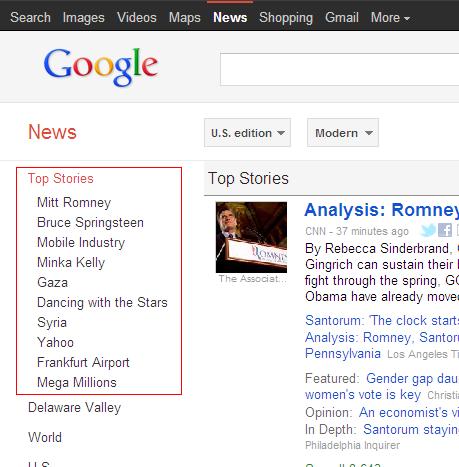
No disrespect to The Boss or Minka Kelly, but what does this say about our culture?

Posted in Culture-Economics-Society | Leave a comment

A Bedtime Story

There once was a group of business owners who owned competing businesses. These business owners formed an oligopoly: between them they controlled nearly all of their nation’s trade in their product. As members of an oligopoly tend to do, these business owners banded together in collusion–something which was illegal in that country–yet they were granted a special exemption from antitrust legislation by their government.

These colluding businessmen (nearly all were male) were constantly looking for ways to gain a negotiating advantage over their employees, who had also instituted collective bargaining. After years of scheming, the business owners devised a new and innovative way of lowering their labor costs.

Labor is, in many industries, the primary cost to employers, and this oligopoly industry was no exception. Hiring employees involves quite a bit of uncertainty: an employee may add more value to his employer’s product than he costs that employer in wages–or he might not. So, the business owners thought, what if there were a way to force prospective employees to work for no wages for up to five years? Then, those of the best quality would rise to the top. The prospective employees would then bear all the risk: if they were injured on the job, they would receive no compensation for lost wages.

The business owners set about putting this plan into action. They set up a dummy corporation, for which all prospective employees in the industry must work for a minimum of a year, and often up to five years. The employees of this dummy corporation were paid less than minimum wage (even though their managers made top salaries). The profits from this dummy corporation were paid to the business owners’ wealthy friends, who in turn passed those profits to the business owners through various legal channels.

The employees targeted by this dummy corporation were mostly poor and members of minority groups. Often these employees worked for four or five years for next to nothing, hoping to prove themselves worthy of a big payday. Yet most did not make the cut, and many sustained serious injuries for which they received no compensation or disability benefits.

But the business owners cared little. The profits rolled in: the most productive employees–the lucky few–made it into the industry proper and made a decent living for several years (before sustaining serious injuries). The managers of the dummy corporation made nearly as much as the oligopoly businessmen. But the majority of the prospective employees, who were often the most gifted members of their struggling communities–continued to squander their most productive years, making millions of dollars for other people, and putting their livelihoods at risk, in the slim hopes of achieving a chance for a single big paycheck for themselves and their loved ones.

And that, boys and girls, is why we have college basketball and football. Sweet dreams!

Posted in Culture-Economics-Society | 2 Comments

Of making many books there is no end, and much study is a weariness of the flesh

I haven’t had much time to blog over the last two months. I know that my faithful readers check daily for updates and are disappointed. I beg your forgiveness…

When I returned from South Africa after a successful thesis defense and a vacation with my bride, I dove (or dived) right into papers for ETS and SBL spring conferences. Both conferences were enjoyable, and my work was well-received. My ETS paper is posted on the Papers & Presentations page; I did not post the SBL paper because I am hoping to publish it very soon. My MTh thesis, “From Time-Bound to Timeless: The Rhetoric of Lamentations and its Appropriation,” is linked as well.

I’m currently throwing all my energy into my dissertation proposal, which I hope to have completed by the end of April. I am also teaching a summer graduate class at PBU in June, so May and June will be devoted to preparation/grading.

Daniel is as cute as ever, and he learns more words each day. He is having a difficult time learning that he must not stand on the couch, or touch the microwave or TV. He spends quite a bit of 30-second segments in “timeout.” But he is a pleasant boy who loves his parents and his grandparents, and is generally healthy and happy. We are grateful.

I am visiting PBU and Westminster today, adding briefly-annotated bibliographical entries to my Chronicles notes…

Posted in Research, Travels | Leave a comment

Links: 5 March 2012

December 30, 2011: The day that never happened (in Samoa).

An interesting article in BAR: "Cultic Practices at Tel Dan—Was the Northern Kingdom Deviant?" I typically hate archeology, but this article is relevant to my research into the periods of the late monarchy, the exile and the postexile. Any thoughts?

Another humorous critique of the state of American higher ed. Full disclosure: I have three degrees (including two master’s degrees) in biblical studies–yet I work in the pharmaceutical industry.

Posted in Links, Uncategorized | Leave a comment

Conference Paper: “Economic Failure of the Torah?”

Yesterday I attended the Eastern Regional meeting of ETS with my sister, Rebekah Devine.

In past years, I have attended these meetings for the fellowship, for the book sales, and sometimes to present a paper–without much interest in the keynote speaker or the plenary topic. This year’s speaker and theme, however, were excellent. Peter Leithart spoke on his new book, Defending Constantine. I am not a Patristics scholar–nor am I the son of a Patristics scholar–but I found Leithart’s presentation compelling as history. As someone associated with the so-called “Federal Vision,” Leithart drew the FV-theonomist-Reformed crowd from PBU and elsewhere, so it was nice to connect with old friends.

Dr. Leithart was so gracious as to attend my presentation during the opening parallel session: “The Economic Failure of the Torah? Toward a Post-Industrial Reading of an Agrarian Text.” I was very pleased with the attendance and the feedback, including some comments from Dr. Leithart and Dr. Todd Mangum from Biblical Seminary. If you are interested in reading and/or hearing the presentation, the PDF and MP3 audio are posted on the Papers and Presentations page.

Rebekah received one of the prizes in the graduate student paper competition for her paper entitled, “No god Made With Hands: Pauline Idol Polemics.” Her paper will soon be posted online, along with the other winning submissions, on the ETS website.

What a fun day! Soli Deo Gloria.

Posted in Research | 1 Comment

Review: “Lamentations and the Tears of the World”

Kathleen O’Connor. Lamentations and the Tears ofthe World. Maryknoll, N.Y.: Orbis, 2002.

O’Connor’s purpose is to recommend Lamentations as an instrument of personal and communal healing. Lamentations’ “theology of witnessing” is for her a theological antidote to blind praise amid suffering, as well as a way of validating pain and protesting suffering in the world. Part I consists largely of commentary on the text of Lamentations, chapter by chapter and section by section (or “panel”). Part II consists of thoughtful reflections upon Lamentations’ theology, purposes, and applications for the individual and the community.

Chapter one describes the purpose of Lamentations, which is at its core the expression of suffering and pain, rather than explanation or comfort. She observes, “Lamentations is not depressing; it cannot cause sorrow, hostility, or despair; it cannot evoke emotions readers do not already know. Rather than creating pain, it reveals pain” (3). In a Western culture that tries to cover, ignore or drown out pain, Lamentations is a breath of fresh air and cool honesty. Lamentations is testimony of a bitter, wounded and unhealed people who sit amid the wreckage of society, religion and life.

One of the strengths of O’Connor’s work is her recognition of poetic form and its relevance to interpretation. The use of acrostic form, multiple perspectives/voices, the personification of Jerusalem as a woman—these are all tools used deliberately and sharply by the poet(s) to communicate pain and protest with cool, horrific calculation rather than dismissible hysteria.

In chapter two, O’Connor demonstrates the nexus between the acrostic form and the content of Lamentations 1. The narrator’s perspective (1:1-11b) is that Daughter Zion is responsible for her own fall; she has been an unfaithful wife to YHWH. Zion, by contrast, desires a hearing, any attention that could be paid to her suffering:

The deepest need of Zion is for God to see, to become aware of the way events are destroying her. She admits her sinfulness, but she knows her attacking foes are not free of sin either….If only God would look, pay attention, hear, then God might learn how much her world and her life are in chaos. God might change things, might comfort her, or at least, might stop attacking her and destroy her enemies. (28)

In Lamentations 2 the observer is drawn more to Zion’s interpretation of the situation, and the focus shifts from Zion’s suffering to YHWH’s agency. The first panel of poetry, 2:1-10, describes in great detail YHWH’s unrelenting attack. By 2:11-19, the second panel, the observer is wholly on Zion’s side, empathizing with her pain, acknowledging the role of foreigners, and giving her advice. Suffering of her children is the ultimate, indescribable, unquantifiable terror and despair. The observer despairs of “bearing witness” (`od) for her (2:13), but that is actually the very thing she wants (39). If Zion is not primarily to blame, who is? Prophets, passersby, enemies, but ultimately it is YHWH’s fault (2:16-17). The narrator successfully incites Zion to protest in the third panel (2:20-22). God does not respond, nor does Zion speak from here on in the book. But she has gained an advocate: the narrator (43).

Lamentations 3 introduces the geber, “strongman,” a protector who is unable to fulfill his role. O’Connor observes that the imbalance in length between Lamentations 1-2 and 4-5 prevents Lamentations 3 from being considered the unambiguous center of the book, “dumping cold water on optimists seeking a quick escape from the book’s painful world” (45). The geber levels two complaints against YHWH: 3:1-21 and 3:42b-66, surrounding a section concerning YHWH’s divine mercies (3:22-42a). The first complaint is that YHWH has attacked him and his people. After reflecting on YHWH’s mercies and his own culpability, the second complaint concerns YHWH’s promised forgiveness for sin. “We have done our part” in confession, but YHWH has not forgiven and restored them (53). Lamentations 3 is “theologically conflicted,” with elements of hope and despair. The “decentering of the book’s hope” in Lamentations 3 is not the absence of hope, but the recognition that “hope is one experience of survival, one interlude in coming to grips with tragedy” (57).

In chapters five and six, O’Connor once again reflects upon the effect of the poetic form on the meaning of the book: “I assume Lamentations to be a carefully crafted work of art and that the variations in form and length express meanings” (71). Everything about this Lamentations 4 is abbreviated: the acrostic is only 44 lines, the lines themselves are shorter, the narrative voice is less personal, and the tone is somewhat diminished—yet the content is still horrifying. Lamentations 5 is yet shorter than Lamentations 4, and abandons the acrostic form—an abandonment which “signifies an abandonment of efforts to contain suffering within a recognizable alphabetical order” (71). “The refusal of resolution enables the book in its turbulence, conflict, and confusion to portray pain without compromise” (71). Terseness and bluntness characterize these two chapters. The community together describes the hopelessness of the attack (4:17-20), and lashes out in anger against its enemies (4:21-22). The passing of the cup to Edom implies that YHWH’s judgment will soon pass not only to Edom but away from Judah: “Amelioration of pain must surely follow….In the future, things will get better, but that future may be distant indeed” (69). The two sections of Lamentations 5 describe “What God should see” (5:1-18) and “What God should do” (5:19-22). After focusing YHWH’s attention on all that has befallen them, the people hope for “a double-edged movement”: YHWH will return to them, and they will return to him. Yet the book concludes without hope—hope that is present in Lamentations 3 but that the book “cannot sustain” (79). “To do so would be to lie, to cover over, to deny the reality of the survivor’s longing for God’s missing voice” (79).

In chapter seven O’Connor addresses the silence of God in Lamentations. If a hypothetical “Lamentations 6” had been composed with an answer, “no matter what God said, Lamentations would come to premature resolution, and the book’s capacity to house sorrow would dissipate” (85). Lamentations in this way “honors truth-telling and denies ‘denial’” (86)—denial that most of the world lives in relative poverty and insecurity, denial of family tragedies, and denial of pain. Lamentations mirrors human sorrow and permits it to stand unmitigated and unanswered—“It calls us to see” (94-95).

Chapter eight builds a theology of witness from the transformation of the narrator in Lamentations, who “is changed by seeing and hearing and attending to the pain of Zion” (109). What a sufferer requires, more than anything else, is for someone to see his/her pain and empathize. Efforts to comfort by finding “a silver lining in a cloud,” or by comparing suffering, trivialize suffering. Lamentations is able to “summon us to our despair, personal and cultural” (109). It is only when we fully acknowledge our suffering and the suffering of others that healing can begin. But O’Connor does not paint a clear picture of what healing looks like in practice; she alludes to “victims regaining power” (102), but does not sufficiently address the danger of abused becoming abuser, or the possibility of forgiveness.

Chapter nine reflects on the many ways that interpreters have dealt with Lamentations’ apparent portrayal of God as an abuser. Rather than ignoring or justifying divine abuse, or rejecting an abusing divinity altogether, O’Connor proposes that Lamentations needs to be set within its historical and cultural context and acculturated to modern understanding of God’s causal role in the world. In her view it is “obscene” to hold that God caused the Holocaust, 9-11, etc. (120). Rather, she clings to “hope” that God is powerless amidst evil, rather than its author (122). She is more comfortable emotionally with a non-omnipotent deity (and the consequent philosophical difficulties) than with the idea that an omnipotent deity could allow or cause evil.

In the concluding chapter, O’Connor reflects on the value of laments for our prayers on behalf of ourselves and the world. Such prayers staunchly call God to action, and also drive us to yearn for God. Yet one wonders how O’Connor conceives of the efficacy of prayer to the non-omnipotent deity for which she hoped in chapter nine. In her epilogue, O’Connor attempts to resolve the question raised in chapter seven by expounding Second Isaiah’s response to Lamentations—a response she likens to an apology from an abusive husband (146).

O’Connor’s book is borne out of careful study of the text, but also personal testimony to pain and suffering (xiii). Careful observations on form and content (and the nexus thereof) yield valuable applications for the faithful reader. Yet in attempting to tie the themes together in a coherent interpretation, O’Connor fails philosophically to account for the true depth of the problem of suffering in Lamentations. For faithful readers through the centuries, Lamentations has been simultaneously the unmitigated human protest against God, and the inspired word of God himself—an implicit tension which O’Connor barely considers.

As a Christian interpreter, O’Connor could have found in the doctrine of the incarnation—in which God condescends to enter and experience the worst of human suffering—a deep and profound answer to the proclamation of suffering in Lamentations. Were this merely a commentary on Lamentations, this could be overlooked, but a Christian theological, philosophical or pastoral treatment of suffering needs to include the cross.

Posted in Bible-Theology, Research | 2 Comments

Rent Garments

In 2 Kings 22, the long-lost but newly-discovered book of Deuteronomy is read before Josiah, and the king rends his garments in anguish and mourning over the sins that he and his people have committed apart from knowledge of the law.

In Romans 2:12, Paul writes: “For all who have sinned without the law will also perish without the law, and all who have sinned under the law will be judged by the law.”

I possess the scriptures of the Old and New Testaments, and have read them several times in their entirety. I own more than twenty copies of the Bible, in seven different languages, including seven different English translations. I have three degrees in biblical studies.

I know “what is good and what the Lord requires of me” (Mic 6:8). When was the last time I “rent my garments” in repentance for my sins?

Posted in Bible-Theology | 2 Comments

Links: 11 February 12

An interesting discussion of culture, sports, character and masculinity.

As a fan of both Stephen Colbert and the Citizen’s United decision, I appreciated this take on Colbert’s running gag/critique of the electoral system. The real problem in politics is not the money, but the scope of government oversight. If members of congress had less power, they would not be targets of lobbying, and elections would mean less.

On a recent Econtalk, Russ discusses ethics and the moral foundations of economic behavior with David Rose–a stimulating episode.

Ron Paul fans, take heart!


Posted in Links, Uncategorized | Leave a comment

Back from Africa

The blog has been quiet for the last month. Here’s what’s been going on…

On Thursday, January 26, Corrie and I left home for South Africa. We dropped Daniel off with my mom in NJ, and flew from JFK Int’l first thing Friday morning. It was 16 hours to Jo’burg, then 2 more to Cape Town. We stayed with our friends, Piet and Colette, the first night; then in Stellenbosch for three days, on a game reserve for one night, and in Cape Town for three more, concluding our trip with a Sunday-to-Monday return trip (missing the Super Bowl!).

The trip was wonderful. I successfully passed my third MTh exam on Monday morning and defended my thesis on Monday afternoon. Once I make the final revisions/corrections ordered by the committee, I will graduate “with distinction.” Those revisions are due next Friday, so I started as soon as we got back–most of the technical revisions are done, so all that remain are the clarifying points that the committee requested in a few spots.

The days leading up to the trip were consumed with teaching Sunday school, preparations for travel, studying for the exams, and planning two weeks’ worth of music at church for the team in my absence. Now that I’m back, music picks right back up again for me–practice this evening, worship on Sunday.

I also plan to give two papers this spring at the local SBL and ETS conferences. The ETS paper needs to be in by next Wednesday, so I’m feverishly trying to finish that off amidst my thesis revisions. Then, thankfully, I’ll have a month to work on the SBL paper–it will be an adaptation of a thesis chapter.

After spring papers, I will work on a doctoral proposal, with the goal of submitting in mid- to late-April. After that, I will spend a couple of months brushing up on my German before laying into the doctoral research in July or so.

Many things–many good things. The trip was a wonderful reminder of God’s blessings, especially my wife, Corrie. As much as we missed Daniel, we were glad for the time to focus on each other–and for all the things that we could be free to do without him! He did get sick while we were away, though…

Hopefully I’ll be able to blog some more in the weeks to come.

Posted in Research, Travels | 1 Comment