
I’m very pleased to (finally) be able to announce the publication of two new books that I’ve coedited.
Many of you know that I completed my PhD through Stellenbosch back in 2014, and I have continued to be involved as a research associate in collaboration with faculty colleagues, including my doctoral advisor, Louis C. Jonker, now the Distinguished Professor of Old Testament at Stellenbosch.
Nearly four years ago, some of us began work on a festschrift project for Louis: a collection of academic essays in honor of a person, building on their work, usually written by their colleagues and students. For Louis we actually did two festschriften, which I’m proud to say are now published:
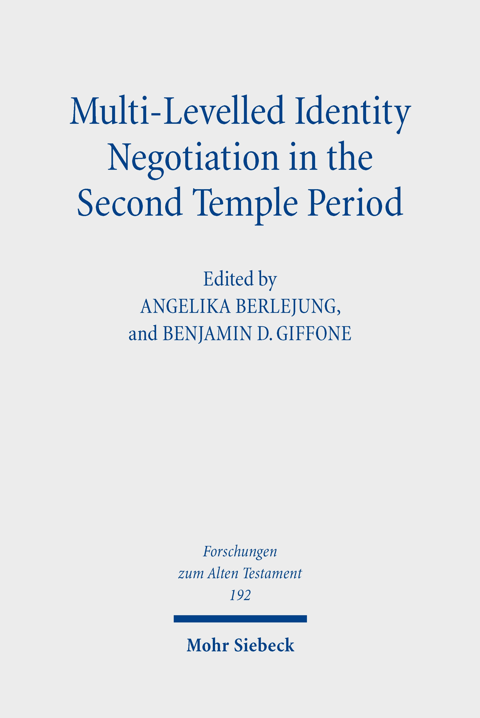

Angelika Berlejung and Benjamin D. Giffone, eds., Multi-Levelled Identity Negotiation in the Second Temple Period: Essays in Honor of Louis C. Jonker. FAT 192. Tübingen: Mohr Siebeck, 2026.
Ntozakhe Simon Cezula, Benjamin D. Giffone, Knut Holter, Lerato Mokoena, eds., Living in Different Worlds Simultaneously: Essays on Biblical Hermeneutics in Celebration of Louis C. Jonker. Eugene, OR: Wipf & Stock, 2025.
At a special afternoon event yesterday, we presented copies of the books to Louis, along with tributes and speeches. Many colleagues and contributors participated virtually from Europe, North America and South Africa—but others came in-person from Germany, Norway, the USA, and elsewhere in South Africa.
Louis was genuinely surprised, and visibly moved to receive these tributes. It was very satisfying to honor a very kind, brilliant and thoughtful mentor. I certainly have a wonderful example to follow in my own teaching and mentoring of graduate students. It was also gratifying to meet colleagues with whom I’d been conspiring for years, many of whom I had never met in person. (And, it was very exciting to pull off a surprise four years in the making, involving dozens of people!)
I’m excited also to finally be able to cite and publicize my own essays in these books, which were substantially completed more than two years ago but underwent review, revision, polishing, editing, etc. Now, the word is out! Here are my contributions, with abstracts:
“Defining YHWH’s ‘Israel’: YHWH’s House and Land in Solomon’s Prayer, in Kings and Chronicles.” Pages 177–199 in Multi-Levelled Identity Negotiation in the Second Temple Period.
This paper explores a tension within the book of Kings with respect to the identification of Northern Israelite territory and people with YHWH.
Solomon’s prayer describes seven envisioned scenarios in which, if YHWH’s people “turn and pray” in or toward the Jerusalem “house,” YHWH would intervene and rescue them—the final scenario (exile) being the most relevant to the audience of the final Kings redaction. The Chronicler adopts this prayer nearly verbatim from Kings, as it reflects key themes of the Chronicler’s theology, including the view of sacred space reflected in the prayer.
However, within Kings itself, the Northern Israelite kingdom and its individuals are described as experiencing crisis moments that parallel the seven scenarios envisioned within Solomon’s prayer (drought, famine, defeat in war, foreigner who prays to YHWH, etc.). In none of these crisis moments is the resolution brought about by YHWH via any connection or reference to Jerusalem or its temple; rather, the resolutions (to the extent that resolutions occur) serve to strengthen the connection between YHWH and Northern Israel apart from Jerusalem. Intriguingly, none of these narratives of crisis is adopted by the Chronicler.
This paper argues that these two definitions of YHWH’s “Israel” exist in tension within Kings: 1) YHWH’s Israel (people and land) apart from Jerusalem and Davidides; and 2) YHWH connected to Israel through Jerusalem. Kings in its received form represents an attempt to negotiate in a single text the centrality of Jerusalem, but also YHWH’s continuing connection to the people and the land of the North. Furthermore, the prayer reads differently within the context of Chronicles, without the aforementioned stories of YHWH’s intervention on behalf of Northern Israel. By the time of the Chronicler’s revisionist history, the relationship of YHWH to Northern Israel has been settled for the Jerusalemite scribal circle in a different way.
“Second Isaiah’s Reception of Deuteronomy’s Monolatry as Protective Strategy: How Do Previously-Known ‘Gods’ Become Unknown Again?” Pages 284–320 in Living in Different Worlds Simultaneously.
Building on the work of Louis Jonker in the areas of identity formation/negotiation and intercultural readings of biblical texts, this paper seeks to situate Isaiah 40–55’s reception of Deuteronomy’s aniconic and monolatrous rhetoric within a polytheistic milieu.
In Deuteronomy’s various sections, worship of deities other than YHWH is portrayed as pointless and degrading due to the non-responsiveness of hand-made images. Within the putative setting of Deuteronomy, this is “predicted” to be Israel’s punishment for disobedience: serving the images of the nations. Yet also sometimes paired with the serving-images warning is the qualification, “gods which you/your fathers have not known” or “gods not allotted to them” (e.g., Deut 11:28; 13; 28:64; 29:26; 32:17). This is puzzling on the grounds of Deuteronomy’s own internal theological logic, and in its reception within the biblical story.
1) In Israel’s origin mythology, Abraham and Terah worshipped Mesopotamian deities in the lands of Ur and Harran. The threat of “gods your fathers have not known” seems to imply that captivity to the gods served by Israel’s Mesopotamian ancestors would have somehow been less bad for Israel than serving other pantheons—for example, the gods of Egypt or Canaan (Josh 24:2–3, 14–15).
2) Moreover, the biblical metanarrative does present the people of Israel and Judah in fact “returning” to Assyria and Babylon as captives, where they were forced to serve Mesopotamian gods—which would seem to be “gods their ancestors had known.”
Both of these observations present difficulties for the monotheistic, aniconic outlook of Isaiah 40–55, whose image-polemics are indebted to the language of Deuteronomy. Thus, the author(s) of Isaiah 40–55 deploy a protective theological strategy in a new cultural setting. In Isaiah 40–55, the exile “predicted” in Deuteronomy represents Israel’s full regression: Abraham’s descendants are now right back in Mesopotamia where they began, captive to Babylonian gods. They are blind, deaf, and hard-hearted as the idols they worship (Isa 42–44). Yet this is worse than the original state of Abraham, because Israel has no longer been apportioned to the Mesopotamian gods (Deut 32:8–9); Israel has been identified with YHWH through the covenants with Abraham and Moses; and Israel has “known” YHWH and vice-versa. Thus, Israel serving and being identified with “gods their ancestors had known” would further degrade YHWH’s people and bring more shame upon YHWH. In Isaiah 40–55, it is now even more urgent that YHWH rescue his people out of enslavement to other deities, than it was for Abraham to leave Mesopotamia or for Israel to leave Egypt. This strategy of simultaneously “remembering” and “forgetting the former things” is a survival strategy for the Isaiah 40–55 community, which places the “familiar” (and ancestral) Mesopotamian deities off-limits for the Yehudians, and asserts YHWH’s covenantal “known-ness” by Israel.

 think hard, think well