This is the audio (26:03, 24.4 MB) of a sermon I preached at the Mill Street (5th-12th grades) campus of Grove City Christian Academy on February 2, 2024. The students have been working through the book of Samuel, and it fell to me to preach from 2 Samuel 7. The Scripture reading by a student was inaudible on the recording, but you can read it here: 2 Samuel 7:8–16, 22–24.
My 13-year-old son came up to be afterward and shook my hand, so I’ll take that as a sign that I didn’t embarrass him (and my daughter) too badly!
This is the audio (21:22, 16.9 MB) of a sermon I preached at the Madison Avenue (elementary) campus of Grove City Christian Academy back on December 8, 2023. The audience was preschool through 4th-grade students, and my texts were excerpts from Jeremiah 18–19.
Our family is working through the book of Samuel in our morning devotions. Even having studied this book extensively–taught OT Narrative Lit several times, and written two books and several articles that touch on the subject–I’m struck once again by how intricate and nuanced the stories are. I have other topics I’m writing on at the moment, but I hope to come back and write an article on the laws (economic, ritual purity, vows, etc.) that are presumed behind the book of Samuel.
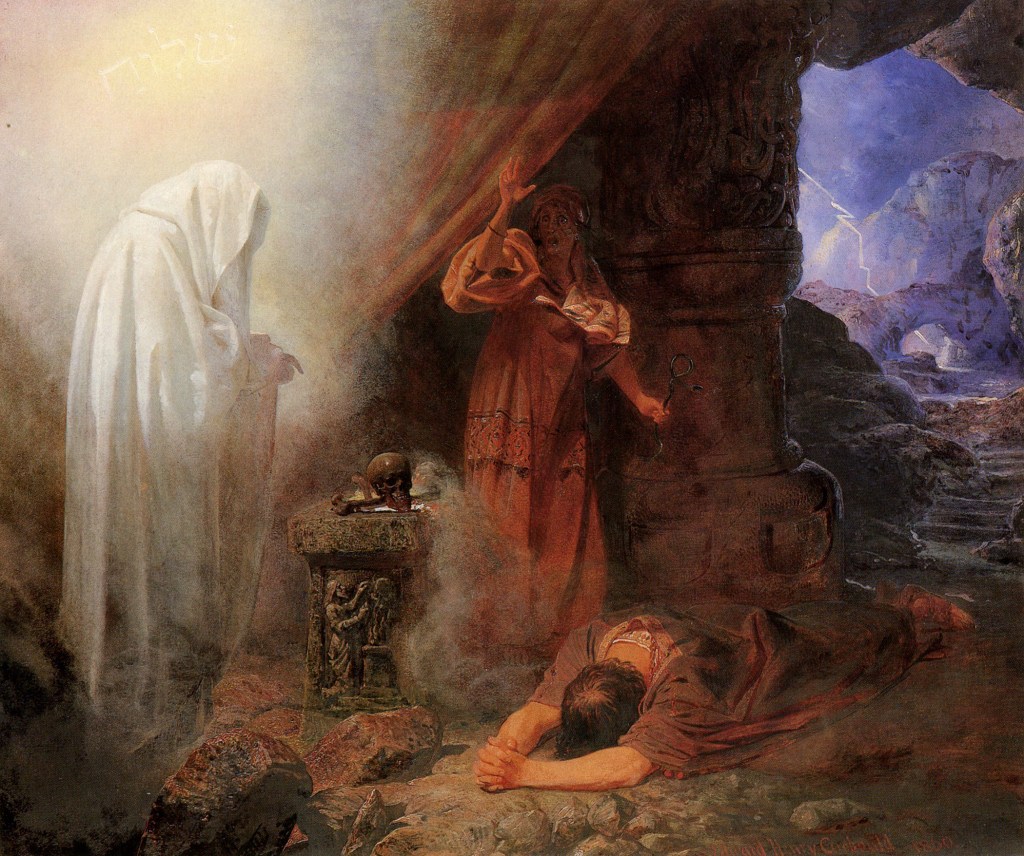
For yesterday’s reading, we looked at 1 Samuel 28, in which Saul consults the medium at En-dor (not this Endor) in advance of his battle with the Philistines, which turns out to be his downfall. There are many interesting aspects to this passage.
I had a student last year who wrote a paper on 1 Samuel 28 in South Asian context. It was a very interesting paper, informed by his Christian community’s encounters with spiritualists and mediums. One of the things that we discovered as he was doing his research, as that historic Christian interpreters have been divided on the question of what exactly the medium (and possibly Saul) actually witnessed when she conjured Samuel’s elohim.
Numerous passages in the Hebrew Bible present Israel as having a unique relationship with YHWH. This relationship begins with the choosing of Abraham and the Patriarchs, and is cemented by the rescue from Egypt, the giving of the Law at Sinai, and the granting of the land of Canaan.
32 “For ask now of the days that are past, which were before you, since the day that God created man on the earth, and ask from one end of heaven to the other, whether such a great thing as this has ever happened or was ever heard of. 33 Did any people ever hear the voice of a god speaking out of the midst of the fire, as you have heard, and still live? 34 Or has any god ever attempted to go and take a nation for himself from the midst of another nation, by trials, by signs, by wonders, and by war, by a mighty hand and an outstretched arm, and by great deeds of terror, all of which the LORD your God did for you in Egypt before your eyes? 35 To you it was shown, that you might know that the LORD is God; there is no other besides him. 36 Out of heaven he let you hear his voice, that he might discipline you. And on earth he let you see his great fire, and you heard his words out of the midst of the fire. 37 And because he loved your fathers and chose their offspring after them and brought you out of Egypt with his own presence, by his great power, 38 driving out before you nations greater and mightier than you, to bring you in, to give you their land for an inheritance, as it is this day, 39 know therefore today, and lay it to your heart, that the LORD is God in heaven above and on the earth beneath; there is no other.”
Deuteronomy 4:32-39 (ESV)
1 Hear this word that the LORD has spoken against you, O people of Israel, against the whole family that I brought up out of the land of Egypt: 2 “You only have I known of all the families of the earth; therefore I will punish you for all your iniquities.”
Amos 3:1-2 (ESV)
However, there are other passages that seem to point to Israel’s non-uniqueness in at least two of those areas. Other peoples are said to have been brought out the midst of certain nations, and some seem to be granted land near Israel’s allotment.
Amos 9:7, despite the special relationship between YHWH and Israel described in 3:1–2, draws parallels to similar exodoi from Caphtor and Kir by the Philistines and the Arameans, respectively:
“Are you not like the Cushites to me, O people of Israel?” declares the LORD. “Did I not bring up Israel from the land of Egypt, and the Philistines from Caphtor and the Syrians from Kir?”
Amos 9:7
In Deuteronomy 2, Moses narrates the Israelites’ journey from the Sinai desert, up through the territory of Edom and Moab, and near Ammon, to their putative location across the Jordan from Jericho. On that journey, the allotments to Edom, Moab and Ammon—peoples descended from Terah—were off-limits to the Israelites. Additionally, the passage describes (from a later vantage point that knows of the Israelite conquest, 2:12c) that these peoples also destroyed/displaced the previous inhabitants, who were giants that the Israelites called Rephaim or Anakim.
Esau/Edom
Moab
Ammon
Fourth generation from Terah
Through Abraham, Isaac; “our brothers” (2:8)
Through Nahor, Lot (and Lot’s daughters); “the people of Lot” (2:9) “the sons of Lot” (2:19)
Land grant from YHWH; Israel forbidden from taking it
2:5
2:9
2:19
Former occupants of the land, tall as Anakim, among the Rephaim
2:12, 22: Horim
2:10: Emim
2:20–21: Zamzummim
Deuteronomy 2: The Land Grants and Conquests of Israel’s Cousins
The passage also notes that “Caphtorim from Caphtor” destroyed the Avvim who lived in/near Gaza (2:23). Elsewhere, the Philistines are said to come from Caphtor (Gen 10:14//1 Chr 1:12; Jer 47:4; Amos 9:7)
What to make of these other exodoi and conquests? Was Israel that unique among the nations? Yes, and no. We know nothing of these other migrations/departures orchestrated by YHWH, but Deut 4:32–34 would still indicate that they were nothing as spectacular as the salvation of Israel from Egypt. There is no record in Israel’s Bible of anything like a Sinai covenant or law given to these other nations.
Moreover, at least with the “conquests” and land-grants of Edom, Moab and Ammon: these allotments can be understood as “secondary blessing” because of these nations’ connection to Abraham. In Genesis 21:13 YHWH affirms to Abraham that even though his elder son, Ishmael, is not the child of promise, Ishmael will nevertheless be blessed and become a great nation for Abraham’s sake.
However, it is interesting to consider the Hebrew Bible’s reflections on YHWH-orchestrated exodoi, migrations and conquests, besides the Israelite exodus from Egypt and the conquest of Canaan. Later texts explicitly affirm YHWH’s sovereignty over the actions of great empires such as Assyria (Isa 10:5–19), Babylon (Isa 14:3–21) and Persia (Isa 45)—therefore, he could certainly have had a hand in the migration and liberation(?) of smaller peoples, as well.
In Deuteronomy’s passages describing the worship of other deities besides YHWH, several passages add an additional qualification: “gods which you/your ancestors have not known.” Sometimes this is connected to warnings against serving other gods (e.g., Deut 13); in other places, serving “previously unknown gods” is part of the punishment of exile (e.g., Deut 11:28). This specification is puzzling in its implication, and in its eventual fulfillment.
1) The “serving other gods” punishment is sometimes paired with language that apparently presumes that “gods of wood and stone” are unresponsive idols without correspondence to any spiritual reality. Worshipping such idols (eventually in Mesopotamia, in exile) is therefore fruitless and degrading for Israel (and the nations), but serving Mesopotamian idols would not necessarily be any more harmful than others.
2) Another possibility is that the nations (and Israel, voluntarily or in captivity) who reverence those images in fact serve rebellious elohim, former members of YHWH’s Divine Council. Not all “other gods” are identical; the pantheons of Mesopotamia, Egypt, and Canaan are described in the Hebrew Bible as possessing distinct characteristics and pathologies. Abraham, Terah and Nahor worshipped Mesopotamian deities in the lands of Ur and Harran. If spiritual realties stand behind the idols of the nations, then one might assume that worship of all “other gods” would be equally offensive to YHWH (Deut 5:7) and destructive/degrading for Israel. Would serving gods that did have some similarity to the gods served by Israel’s Mesopotamian ancestors have been any less bad for Israel than serving random gods—or the gods of Egypt or Canaan, for that matter? If not, then the “gods your ancestors have not known” threat seems pointless.
3) Finally, in the eventual fulfilment of Deuteronomy’s warnings, the people of Israel and Judah did in fact return to Assyria and Babylon as captives and were forced to serve Mesopotamian gods. How then are these “gods which you/your ancestors have not known”?
This paper argues that the Babylonian exile is presented in Deuteronomy, and also in passages such as Isaiah 40–55, in one sense as degenerating “back to Square One”: Abraham’s descendants are now right back in Mesopotamia where they began, captive to Babylonian gods. They are blind, deaf, and hard-hearted as the idols they worship (Isa 42–44). Yet this is worse than their original state, because Israel has no longer been apportioned to the Mesopotamian gods (Deut 32:8–9); Israel has been identified with YHWH through the covenants with Abraham and Moses. Israel serving and being identified with “gods their ancestors had known” would further degrade YHWH’s people and bring more shame upon YHWH. In Isaiah 40–55, it is now even more urgent that YHWH sanctify his people and call his people out of Babylon than it was in Genesis 12: For the sake of YHWH’s name. This theological reading of Deuteronomy and Prophetic texts has implications for interpretation of several NT passages relating to demonic possession, apostasy, and the honor/shame dynamic of soteriology.
I have a destination in mind for this paper (a volume I am coediting). If you have any thoughts or comments to share on this paper, please email them to me.
I have been deliberately obscure on the details of certain matters related to my separation from my last church. The presenting issue of my disagreement with the elders was a building project, but that was not the underlying issue–the issue was a lack of regard for church unity.
Nevertheless, in the months leading up to the confrontation over unity and direction that eventually compelled me to resign, I did a lot of research for Session discussions about building projects and fundraising. There is a lot written about the strategy of fundraising and the leadership considerations, and I would not want to reproduce that wisdom here.
As a pastor who is also a biblical scholar, I felt that there were many different passages that could be used to develop a biblical theology of fundraising, and I presented those to Session as part of our process. I’m presenting these here for the benefit of churches who are contemplating fundraising for a building project, especially a building/addition used for recreation or other ancillary ministries (i.e., not a sanctuary for worship).
I’ve been in San Antonio this week for academic conferences. This is my first time attending/presenting at ETS since 2015, and first time in person at SBL since 2018.
My approach to these conferences has shifted over the years. Early on as a grad student and young PhD, I felt the need to go to as many sessions as possible and pick up as much information as I could. Now, my focus is more on networking: trying to meet people whose work is important for mine, and connecting with them after the conference for future collaboration. I do go to some sessions, but often just to meet specific people afterward.
My approach to presenting papers has shifted, too. Young scholars often present too long and focus too much on method and background, to show that they’ve done their homework. This misses an opportunity, however, to test out key aspects of your hypothesis in a room full of smart people.
"…No living human Other ever perfectly reflects you back; a relationship is not just about natural compatibility but growing into compatibility. By contrast, AI girlfriend/boyfriend/hentaifriend/otherkinfriend will reflect your desires back better and more completely than any individual human could. Thus the logic of sexual technologisation reverses into AI girlfriend."